Trabajos de ejemplo generados con Dreamina Seedance 2.5 — exhibidos en el BytePlus ModelArk Gallery. Cada clip incluye el prompt original completo usado para generarlo.
Wonder Boy
Open-sourceSeedance 2.5
BytePlus Presents · Michael Owen Featuring · 7 clips
Película de IA con Michael Owen como protagonista. Generada con Seedance 2.5. This content is generated by AI.
Open Source Lens — 7 clips con prompts
Clip 01 00:00 - 00:13
Reference images: Image1 (Chester street setting), Image2 (boy's identity and clothing), Image3 (Owen's identity and kit), Image4 (football design), Image5 (defenders' kit), Image6 (street-side pub setting).
Create a premium, strongly commercial football TVC set on the streets of Chester in 2006. Ma...
Reference images: Image1 (Chester street setting), Image2 (boy's identity and clothing), Image3 (Owen's identity and kit), Image4 (football design), Image5 (defenders' kit), Image6 (street-side pub setting).
Create a premium, strongly commercial football TVC set on the streets of Chester in 2006. Maintain a consistent mid-2000s atmosphere throughout: an old television, glass shopfronts, vintage buses, street pubs, newspaper stands, brick walls, overcast natural light, and wet stone pavement. Match the established tonal treatment. Stadium advertising boards must contain no text or logos. The boy must remain confident, excited, and curious throughout.
Do not show national flags, team crests, brand logos, sponsor marks, sportswear branding, copyrighted graphics, slogans, legible trademarks, or recognizable landmarks. Use no music, commentary, narration, dialogue, clear chants, or singing. Retain only environmental sound: footsteps, football friction on the ground, water splashes, light glass rattles, old television static, indistinct distant crowds, passing buses, fabric movement, breathing, and the ball striking a wall. The overall result should be coherent, energetic, restrained, and premium.
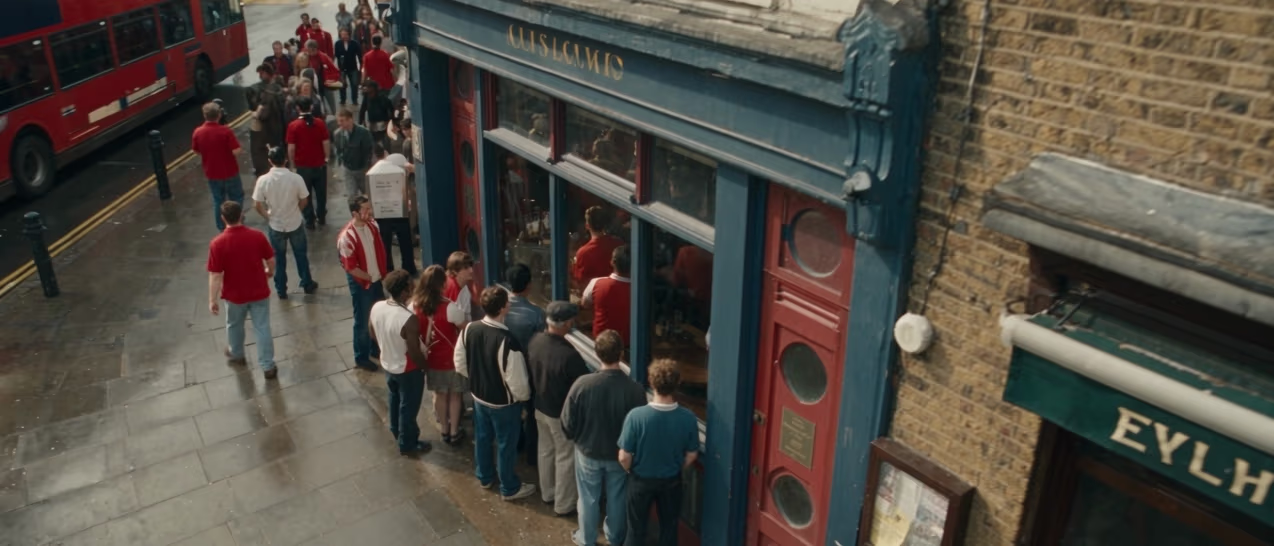
Shot 1: A handheld overhead view descends slowly from above the street, then advances with the boy. Enter an ordinary Chester street matching the established Chester street style and setting. The boy enters from frame left in a rear upper-body close shot, carrying an old football under his right arm and moving lightly and quickly beside the wall. He looks around with curiosity, notices a crowd pressed against the window of an old pub, gradually slows, and becomes absorbed by what is inside.
Shot 2: Film horizontally from inside the pub through the glass with slight handheld movement, framing the boy in a frontal upper-body close-up. He pushes through the crowd to the front, presses his face close to the misted, scratched glass, and peers inside with bright, excited, curious eyes.
Shot 3: Use an over-the-shoulder view from behind the boy's left shoulder, with subtle handheld movement and a slow push-in. Through the glass, reveal a warm, slightly smoky pub where an old television hangs from the ceiling and shows a football match. The crowd stares upward; some grip their glasses, hold their breath, or tap the table. The television has faint scan lines and flicker.
Shot 4: Frame a frontal upper-body close-up of Owen with slight handheld movement, rapidly push in, then stop. Owen stands near midfield, lowers his head slightly, and takes a deep breath without visible condensation. The audience becomes a soft background mass.
Shot 5: Begin with a ground-level close-up from behind Owen's feet and push forward with the action. His foot rests on the referenced football on damp turf while distant teammates remain defocused. At the whistle, he drives through the ball. Emphasize boot impact, turf displacement, and the ball cutting through the air. Keep the first five shots within eight seconds.
Shot 6: From a low upward angle, track the ball as it enters from frame left and moves rapidly forward. At the instant Owen kicks it, transition seamlessly back to Chester. The ball enters from the left and rolls down the street; the boy follows into frame and begins dribbling over the wet stone pavement.
Shot 7: From a low frontal handheld position, track Owen at speed. He advances with the ball, beats a defender with consecutive step overs and a sharp shoulder feint, and shifts his center of gravity rapidly while the background stretches into motion blur.
Shot 8: Match the movement back to the street. Track backward from a low frontal handheld angle as the boy dribbles through pedestrians. The ball stays close to his toes before he knocks it out of frame right. Use subtle shake and a brief snap zoom to strengthen the live-action advertising energy.
Shot 9: In a handheld medium close shot, follow the ball falling from above and tilt quickly down to Owen's feet. A pass arrives from the left; Owen controls it cleanly with his chest, leans back slightly, and the camera follows the ball precisely from chest to ground.
Shot 10: Follow the upper body handheld, then cut rapidly down to the ball and feet as the boy passes on frame right. A football rolls across wet stone pavement. An office worker reading a newspaper looks up in surprise as the boy runs past, glancing back with an apologetic but excited smile.
Shot 11: Move from a wide exterior view into an interior, pushing forward slowly with the window frame in the foreground so interior and exterior remain visible together. In an ordinary living room, an old television shows Owen on the pitch while a young girl plays on the carpet. Outside the window, the boy flashes past with the ball. His movement mirrors Owen's action on the television, and the girl looks between the screen and the street.
Clip 02 00:13 - 00:25
Reference images: Image1 (Chester street setting), Image2 (boy's identity and clothing), Image3 (Owen's identity and kit), Image4 (football design), Image5 (defenders' kit), Image6 (street-side pub setting).
Create a premium football TVC set on the streets of Chester in 2006, maintaining a consisten...
Reference images: Image1 (Chester street setting), Image2 (boy's identity and clothing), Image3 (Owen's identity and kit), Image4 (football design), Image5 (defenders' kit), Image6 (street-side pub setting).
Create a premium football TVC set on the streets of Chester in 2006, maintaining a consistent mid-2000s atmosphere through old televisions, glass shopfronts, vintage buses, street pubs, newspaper stands, brick walls, overcast natural light, and wet stone pavement. Stadium advertising boards must contain no text or logos. The boy remains confident, excited, and curious throughout.
Do not show national flags, team crests, brand logos, sponsor marks, sportswear branding, copyrighted graphics, slogans, legible trademarks, or recognizable landmarks. Use no music, commentary, narration, dialogue, clear chants, or singing. Retain only environmental sound: street footsteps, football friction, splashing water, glass rattles, old television static, indistinct distant crowds, passing buses, fabric movement, breathing, and the ball striking a wall. Keep the sequence coherent, energetic, and premium.
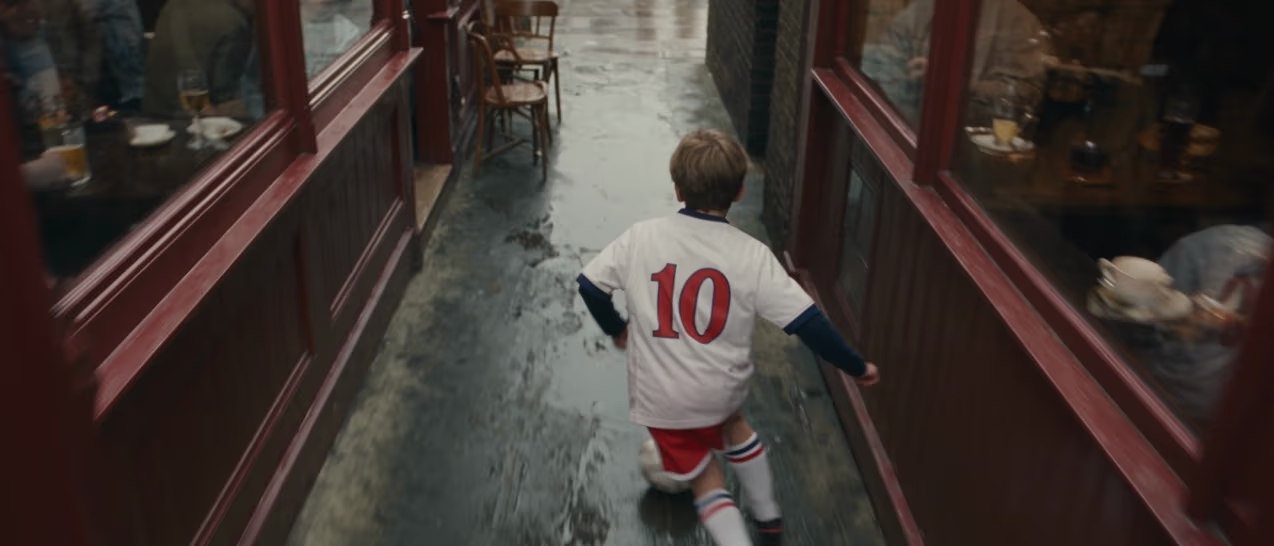
Shot 10: Use a vertical overhead handheld view that advances rapidly from behind the boy. He dribbles through a narrow alley while people in shops on both sides watch and become drawn into the excitement. He lowers his center of gravity, makes two small changes of direction, and carries the ball beneath a chair.
Shot 11: Film the football from a low horizontal angle while retreating quickly in front of the action, followed by a short snap zoom. Return to the World Cup pitch and frame only the legs. The ball passes between a defender's legs; Owen runs around him, continues at speed, and quickly releases a pass.
Shot 12: From street level, push rapidly toward a close shot of a person on a second-floor balcony. Matching the previous ball trajectory, the ball flies past the camera. A British elderly man in a sweater holds a cup of tea and looks down at the street; the tea trembles, he raises an eyebrow, and smiles in amusement.
Shot 13: In a semi-interior space such as a pub entrance or residential doorway, begin with a handheld medium shot and push rapidly toward the feet. The ball rolls to a passerby, who reacts instantly, gives it a light juggle, and kicks it cleanly back into the street as an effortless street-football relay.
Shot 14: Return to the pitch with a handheld tracking shot close to Owen's upper body and shoulders. Owen drives at a defender, uses a shoulder feint to change direction, and the camera whips laterally with his movement.
Shot 15: Use a passerby's handheld point of view. Continuing the previous movement, the boy approaches a street musician playing guitar and performs a rainbow flick in slow motion, sending the ball in a clean arc over the musician's head. The camera follows the ball as the boy runs around the musician, regains possession, and continues his sprint.
Use a handheld medium shot, tracking backward rapidly from directly in front of the boy. The boy dribbles forward at high speed. An old-fashioned bicycle suddenly emerges from a street opening on the right and brakes sharply in front of him, its front wheel swaying slightly. Without slowing down, the boy performs two consecutive stepovers, moving the ball quickly from side to side and drawing the cyclist's center of gravity with it. The instant the cyclist hesitates, the boy nudges the ball with the outside of his foot, slips it past the bicycle's front wheel, and runs around the other side. The cyclist looks back at the boy, pauses in surprise, then smiles with admiration, mounts the bicycle again, and follows the group at an unhurried pace.
Use a vertical overhead view and rotate with the characters. Three young pedestrians surround the boy from different directions. He performs consecutive stepovers, drags the ball with the sole of his foot, then turns sharply and sends the football between one person's legs. Rotate halfway around the group so the ball's route and the changing positions of the people remain clearly visible.
Clip 03 00:31 - 00:41
Reference images: Image1 (boy's identity and clothing), Image2 (football design), Image3 (Chester street setting).
The scene takes place inside a cafe. A football rolls through the interior as the boy dribbles at speed, followed loosely by approximately ten pedestrians. Keep seated customers, people...
Reference images: Image1 (boy's identity and clothing), Image2 (football design), Image3 (Chester street setting).
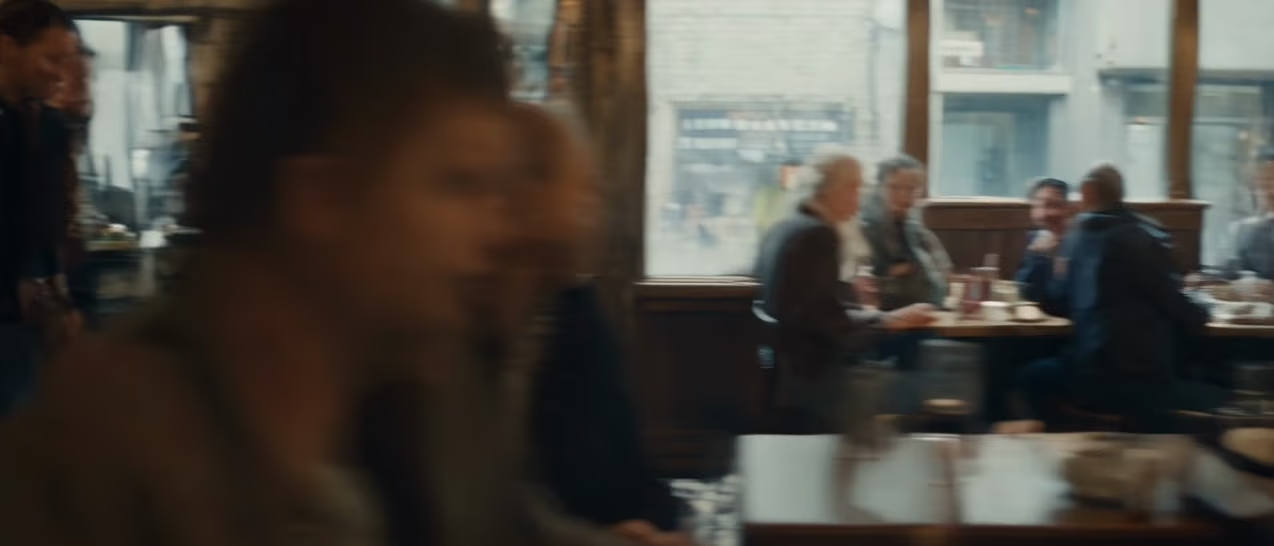
The scene takes place inside a cafe. A football rolls through the interior as the boy dribbles at speed, followed loosely by approximately ten pedestrians. Keep seated customers, people at the entrance, and the distant line of followers visible within the same composition to create layered and spatially complex crowd staging.
Place the camera inside a park bench and film from a low angle. The boy dribbles toward the bench. The football rolls beneath it first; the boy makes a light jump around the side, then regains possession on the far side. The young couple seated on the bench look down together at the ball rolling past their feet, exchange a smile, then stand and join the group.
The boy dribbles through a narrow street opening while the camera retreats from a front-side angle. The football stays close to the road surface, and sunlight casts crisp, hard shadows across the rough asphalt. He gently guides the ball around a cardboard box, then uses the inside of his foot to pass it between two children, smiling as though he enjoys being chased. Behind him follows a street crowd of varied ages, occupations, and body types: students with schoolbags, maintenance workers in work clothes, vendors in aprons, a young mother pushing a stroller, middle-aged shoppers carrying bags, office workers in suits, and an enthusiastic elderly person with a cane. They run and laugh as the improvised street football game draws them in.
Clip 04 00:41 - 00:56
Reference images: Image1 (Owen's identity and kit), Image2 (boy's identity and clothing).
Begin with a wide side view and transition briefly into slow motion. Owen instinctively jumps over an opposing player sliding toward him. His leg is lightly clipped in mid-air, shifting his center of gravity fo...
Reference images: Image1 (Owen's identity and kit), Image2 (boy's identity and clothing).
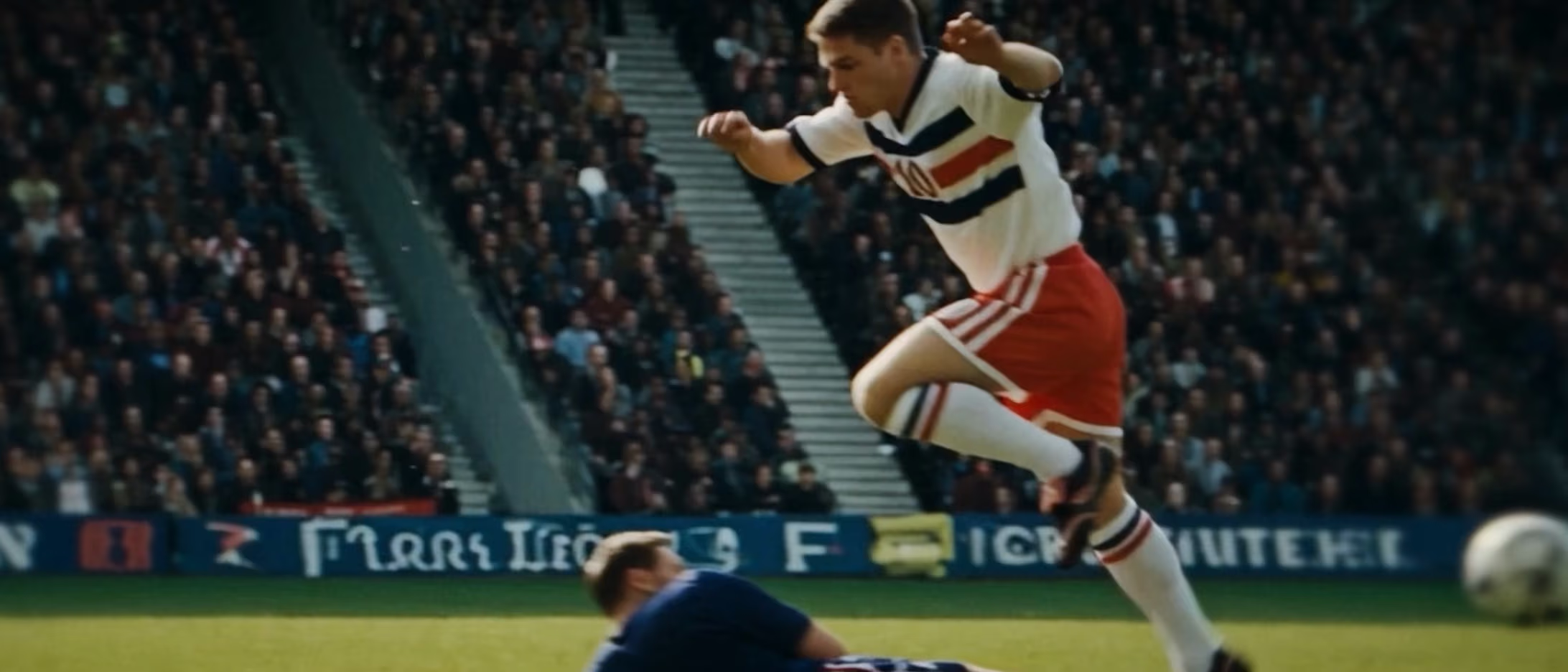
Begin with a wide side view and transition briefly into slow motion. Owen instinctively jumps over an opposing player sliding toward him. His leg is lightly clipped in mid-air, shifting his center of gravity forward and to the side. He lands on one foot, his boot slips on the grass, and he throws out both arms to regain balance. The camera pans toward the direction of his fall with a slight delay.
Begin with a front-side medium shot, move into a high overhead angle, and maintain continuous slow motion. The boy's momentum still carries him forward; both feet briefly leave the ground, his torso rotates slowly, his arms open instinctively, and his fingers stretch with tension as his expression changes from concentration to alarm. As his body falls, the camera rises into an overhead view. Reduce the speed to one fifth just before his palm touches the ground, then return abruptly to normal speed at the instant of impact and add a short camera jolt.
Under soft overcast light, the boy lies on his side on the road with his palm and knee against the ground, his expression still fixed in the shock of the fall. He blinks as though he has not yet understood what happened. Pain gradually sets in: his brow tightens, his lips part and then press together, and his breathing quickens. People of different ages stand in the distance; students, vendors, workers, and passersby remain compressed into soft silhouettes. Do not show their individual reactions. Keep all attention on the boy.
In a dim, warm living room, six young football supporters sit tightly grouped around a television positioned just outside frame left. Cool screen light falls across every face. Everyone is frozen in extreme tension: the man in front leans low with his elbows on his knees and fists clenched; the man in the middle interlocks his fingers, leans far forward, and stares at the television; the blonde woman covers her mouth with both hands and raises her shoulders as if afraid to breathe; the man in the back holds his head with both hands and remains rigid; the person on the right holds their breath with lips slightly parted. No one speaks or makes any large movement. Show only subtle swallowing, blinking, tightening fingers, and gradual forward leaning. The room seems to fall silent, leaving only the match audio, urgent commentary, and restrained breathing. Push forward handheld to intensify the relationship between the viewers and the television. At the instant of the shot, everyone involuntarily leans forward.
Inside a moving Chester city bus at night, use a gently swaying medium close shot facing the front seats. A white-haired elderly man holds a phone horizontally with both hands and watches a football match. A white middle-aged man in a white shirt grips the seatback in front of him with one hand and leans toward the phone. Behind them, a young Black man remains seated and leans slightly between the two to see the screen. When the match takes an unexpected turn, the elderly man stops breathing and tightens his fingers around the phone. The man in white parts his lips, furrows his brow, freezes in his forward-leaning position, and leaves his other hand suspended in mid-air. The younger man slowly raises his chin, his expression changing from confusion to disbelief; his lips part, one hand rises gradually to cover his mouth, and the fingers of his other hand tighten around his knee. The bus sways gently through an intersection, and all three move with its inertia while remaining transfixed by the image on the phone.
Use a distant view of a long, dark player tunnel. After a slight defocus and camera tremor, focus on the bright rectangular opening at the far end of the deep, silent corridor. The tunnel lights are initially off, then illuminate slowly one by one from near to far. Having completed his recovery, Owen stands alone at the entrance to the tunnel and begins running forward after the lights come on.
Do not display subtitles, captions, lower-thirds, score graphics, logos, or any other on-screen text.
Clip 05 00:56 - 01:05
Reference images: Image1 (football design).
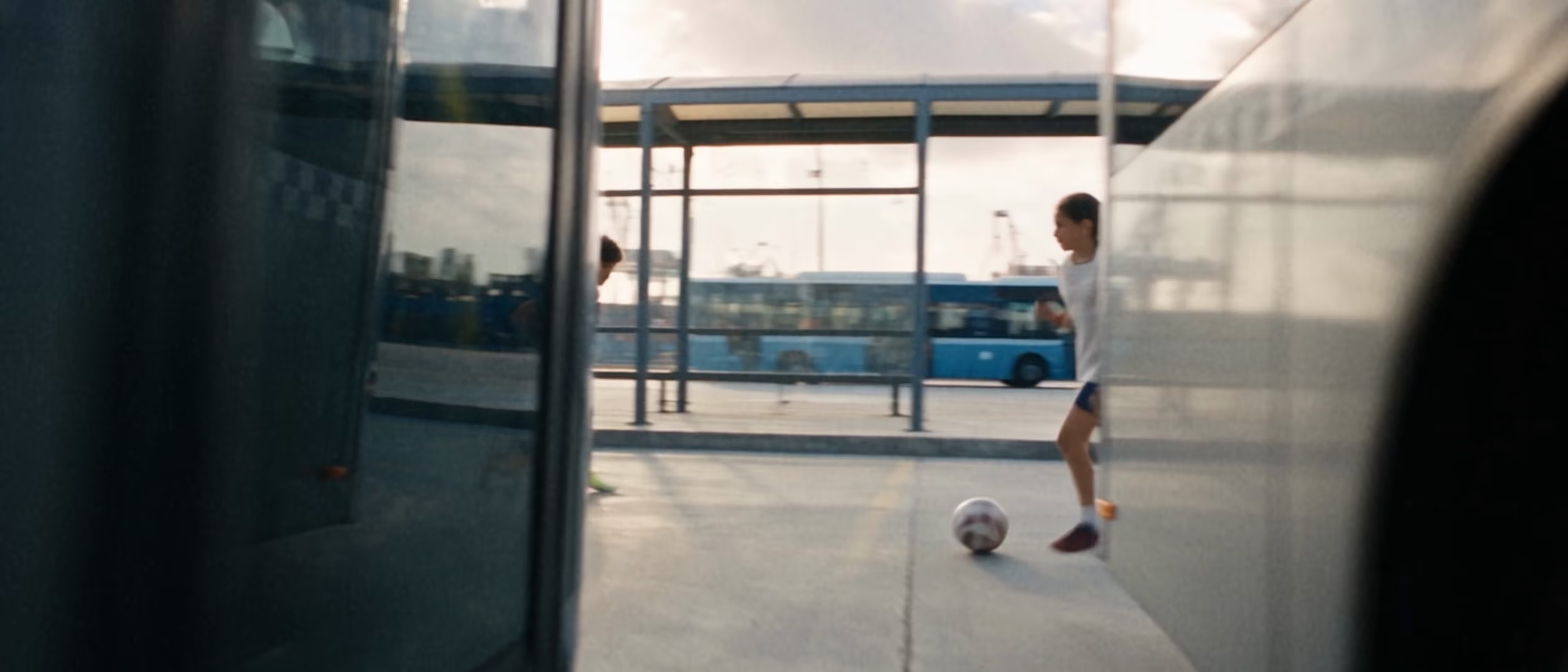
The football is already moving between two stationary buses as an approximately eighteen-year-old girl dribbles from right to left. The bus windows reflect blurred images of her and the pursuing players. Begin by filming the action through the reflection o...
Reference images: Image1 (football design).
The football is already moving between two stationary buses as an approximately eighteen-year-old girl dribbles from right to left. The bus windows reflect blurred images of her and the pursuing players. Begin by filming the action through the reflection on the side of a bus. As she approaches, move rapidly away from the reflection and transition into a waist-height lateral tracking shot parallel to her movement. A defender reaches a foot in from behind. She slows, draws the ball toward the inside of her body, and suddenly turns in the opposite direction, causing the pursuer to run past the camera. She then uses the outside of her foot to push the ball beyond another opponent.
A fourteen- or fifteen-year-old boy is already dribbling rapidly along a cobblestone street while several teammates continually change positions between parked vehicles and the pavement. Track diagonally from a low street-side position as the boy approaches from the rear left toward the front right. Facing the first defender, he drops his shoulder outward and then cuts sharply inward with the inside of his foot. Do not retreat as he passes; allow him to cross close in front of the lens, then turn into a rear-side tracking view. A second opponent rushes out from between parked vehicles. The boy drags the ball back with the sole of his foot to avoid the challenge, sends it behind the opponent, circles around the other side, and regains possession. A teammate runs laterally ahead of him; he feints a pass but continues dribbling down the street. Move with the players through lateral tracking, diagonal pursuit, and brief whip pans. End while the dribbling, positional exchanges, and pressure remain in continuous normal motion.
A football rolls from left to right across damp concrete as two young men chase side by side between shipping containers. The camera enters suddenly from behind a container corner and follows rapidly from a low rear-side position. Use a 22 mm wide-angle lens to intensify the compressed distance between the players and the towering containers. The main player braces his shoulder against the opponent and first pushes the ball to the right, then steps around the outside of it and cuts it sharply back to the left. As the defender shifts his weight, the player accelerates again with the outside of his foot and breaks through a narrow passage between two containers. Do not keep the camera locked to the main player: first drift with the deceived defender, then whip back forcefully to recover the ball. As another young man charges in to block, the player delicately lifts the ball over the outstretched foot so it drops toward the camera.
Cut to a fifteen- or sixteen-year-old barefoot boy controlling the ball at high speed on sand while another boy sprints shoulder to shoulder with him and maintains physical pressure. The camera retreats at sand level from a front-side angle, holding a medium close composition from the knees to the chest. The football repeatedly approaches the lens, while the sea appears only as a blurred horizontal strip behind the players. The main boy first lifts the ball lightly with his toe to avoid a challenge from the ground, then drives it forward with his knee as it falls. When the defender turns to block him, he immediately flicks the ball over the extended leg with his instep, circles to the other side, and continues chasing it. Two additional players enter from the edges of frame to contest possession. Sand repeatedly strikes the lens as the camera tilts briefly upward with the ball, then drops rapidly back to ground level.
A falling football bounces on concrete as a fifteen- or sixteen-year-old boy receives it at the edge of a skate platform. Mount the camera low near a skate rail, using the rail as a fast-moving foreground element while tracking laterally beside the player. The boy dribbles along the edge of the slope as an opponent jumps down from the platform to challenge him. He shields the football with his body, drags it backward with the sole of his foot, and turns sharply along the incline. Execute a brief quarter-circle move around the two players, shifting from a side view to a frontal view of the boy. After consecutive stepovers, he suddenly breaks toward frame left and the ball passes close beside the camera. Another player emerges from behind a concrete pillar to receive the ball, and the camera tilts down rapidly to follow it into the next challenge.
On a rural football ground of red earth and sparse grass, low brick houses, wooden fences, and a makeshift goal stand in the distance. Five or six boys chase the football intensely while several companions clap and call from the sideline. A twelve- or thirteen-year-old boy breaks from the group with the ball and changes direction repeatedly with the outside of his foot. Two defenders close in from front and rear; he protects the ball with his shoulder, then cuts sharply between them. Track backward rapidly at an ultra-low ankle-level position close to the ball, using an 18-20 mm wide-angle lens. Players' legs repeatedly cross near the camera, and the handheld image rises and falls with the running movement. Their shoes throw up clouds of red dust. The boy drives a strong pass toward frame right while his companions wave, cheer, and continue the chase.
Begin directly in close physical pressure. A fourteen- or fifteen-year-old boy dribbles from left to right across the frame while another boy continually pushes against his route with a shoulder. Track laterally at knee height from the outside of the two players using a 20 mm wide-angle lens. Their lower bodies, the football, and wind-flattened dry grass dominate the composition; distant yurts and a wooden fence appear only briefly between them. The main player first drives the ball forward with the outside of his foot, then stops it abruptly under his sole so the defender runs past from momentum. He turns and pursues the ball in the opposite direction. Let the camera continue along its original path for half a step before whipping back to regain the player. The boy pokes the ball through another opponent's legs and accelerates into the strong wind until the football rolls out of frame right.
A football rolls rapidly across a waterlogged grass pitch while a fourteen- or fifteen-year-old boy keeps close control and two defenders challenge continuously from both sides. The camera rushes into the group from behind the ball at ground level, using a 16 mm ultra-wide lens at very close range. Players' legs, soaked hems, rain, and splashing muddy water repeatedly obscure the frame, while the perimeter fence and pitch lights appear only as fragments through the rain haze. The boy pushes the ball right with the outside of his foot to avoid the first challenge, then immediately drags it left under his sole so the second defender slides past in front of him. He continues at speed along the touchline. When a third player closes from ahead, he takes two short touches and cuts suddenly inside to break past. A teammate sprints forward beside the camera, the defenders turn to pursue, and the camera continues running with all the players. End naturally during ongoing dribbling, pursuit, and physical contact, with both the ball and camera still in motion.
On rain-covered concrete, a football slides beside an eighteen- or nineteen-year-old girl as two young men close in from left and right. Position the camera almost against the waterlogged ground and retreat rapidly in front of her with a 16-18 mm ultra-wide lens. Her legs, the football, and the defenders' reaching feet fill the frame, while a metal fence and residential windows compress into the blurred background. She first pushes the ball outward with her right foot to draw one defender sideways, then traps and drags it back under her sole before threading through the narrow gap between them. When the second defender turns to continue the chase, she slows abruptly, shields the ball with her body, and pushes it past the defender's toes. As she breaks through, raise the camera rapidly from ground level to waist height. Water splashes directly toward the lens as her boots strike the puddles.
Clip 06 01:05 - 01:17
Reference images: Image1 (boy's identity and clothing), Image2 (football design).
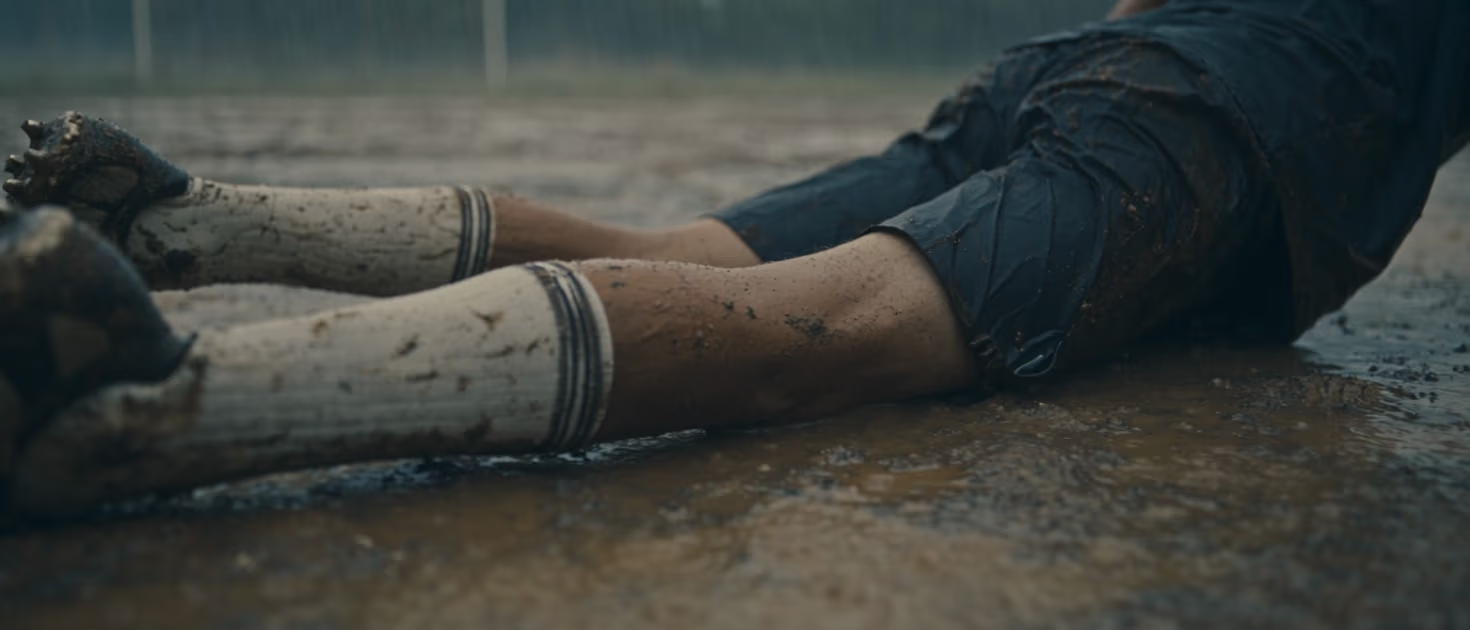
Use a handheld, low-angle side close-up of the boy's legs without revealing his face. He is lying on muddy ground, then plants only his right foot and rises with determination. Show the complete process of standing up ...
Reference images: Image1 (boy's identity and clothing), Image2 (football design).
Use a handheld, low-angle side close-up of the boy's legs without revealing his face. He is lying on muddy ground, then plants only his right foot and rises with determination. Show the complete process of standing up while keeping the framing limited to his legs. Play the action at normal speed with no slow motion.
Use a handheld, low-angle side close-up of the boy's legs without revealing his face. He is lying on the ground, then plants only his right foot and rises with determination. Show the complete process of standing up while keeping the framing limited to his legs. Play at normal speed with no slow motion. No logos may appear on the shoes or clothing.
Use a handheld, low-angle side close-up of the boy's legs without revealing his face. He is lying on muddy ground, then plants only his right foot and rises with determination. Show the complete process of standing up while keeping the framing limited to his legs. Play the action at normal speed with no slow motion.
The boy begins well behind the football and sprints forward for five steps while the camera tracks him from a low upward angle. He reaches the ball and strikes it, sending it through a clean, perfect arc. Play the entire action at normal speed with no speed ramping or slow motion.
Shoot handheld and keep the boy's full body prominent throughout, tracking him from a ground-level upward angle. The setting is a worn tropical South American city with dense, complex buildings and a very small football court. A slight boy in shorts and a short-sleeved shirt runs into frame from behind the camera, remains back-facing throughout, takes his run-up, and strikes a free kick. Three or four young defenders are distributed across different depths of the court: some near the camera, some near the goal, and others at the frame edge. As the ball is struck, they run toward the goal. Keep distant faces soft and unrecognizable, and let the kick throw up dirt and dust. Play at normal speed with no slow motion. No logos may appear on shoes or clothing.
Use a handheld, low-angle side close-up of the boy's legs with the football prominent. The location is a worn outdoor football ground by the sea, covered with dust and mud, with the coastline visible in the distance. The boy takes a run-up and strikes a free kick toward three or four young defenders positioned at different depths. As the ball is kicked, they jump together to block it. Keep distant faces soft and unrecognizable, and let the strike throw up dirt and dust. Play at normal speed with no slow motion. No logos may appear on shoes or clothing.
Shoot handheld, keep the boy's full body prominent throughout, and follow his movement. The setting is a worn South American city with dense, complex buildings and a very small football court. A slight boy in worn clothing runs into frame from behind the camera, remains back-facing throughout, takes his run-up, and strikes a free kick. Three or four young defenders stand ahead at different depths and jump to block the ball as it is kicked. Keep distant faces soft and unrecognizable, and let the strike throw up dirt and dust. Play at normal speed with no slow motion. No logos may appear on shoes or clothing.
The boy begins well behind the football and sprints forward for five steps while the camera tracks him from a low upward angle. He reaches the ball and strikes it, sending it through a clean, perfect arc. Play the entire action at normal speed with no speed ramping or slow motion.
Shoot handheld and keep the boy's full body prominent throughout, tracking him from a ground-level upward angle. The setting is a worn, muddy primary-school pitch in heavy rain, with a damaged goal in the distance, dense surrounding buildings, and very limited space. A slight boy in shorts and a short-sleeved shirt runs into frame from behind the camera, remains back-facing throughout, takes his run-up, and strikes a free kick. Three or four young defenders occupy different depths: some near the camera, some near the goal, and others at the frame edge. As the ball is struck, they run toward the goal. Keep distant faces soft and unrecognizable, and let the kick throw up muddy water and grit. Play at normal speed with no slow motion. No logos may appear on shoes or clothing.
Use a handheld, low-angle side close-up of the boy's legs with the football prominent. The boy takes a run-up and strikes a free kick toward three or four young defenders standing in a loose formation. As the ball is kicked, they jump together to block it. Keep distant faces soft and unrecognizable, and let the strike throw up dirt and dust. Play at normal speed with no slow motion. No logos may appear on shoes or clothing.
Shoot handheld and keep the boy's full body prominent throughout, tracking him from a ground-level upward angle. The setting is a worn tropical South American city with dense, complex buildings and a very small football court. A slight boy in shorts and a short-sleeved shirt runs into frame from behind the camera, remains back-facing throughout, takes his run-up, and strikes a free kick. Three or four young defenders occupy different positions across the court: some near the camera, some near the goal, and others at the frame edge. At the instant of impact, transition into slow motion and follow the football. The strike throws up dirt and dust; the ball deforms slightly and spins slowly as it travels forward. Orbit to the front of the ball so it approaches the lens in slow motion, then return suddenly to normal speed as the ball accelerates into the camera, fills the frame, and cuts instantly to black. Keep distant faces soft and unrecognizable. No logos may appear on shoes or clothing. Use sound effects only, with no music.
Clip 07 01:24 - 01:42
Edit Video1 as a continuous one-take sequence. Preserve the original camera path, timing, shot sizes, composition, pacing, lighting, the seamless transition through the television screen, the pub action, and all picture-in-picture content. Replace only the two principal characters: replace both the ...
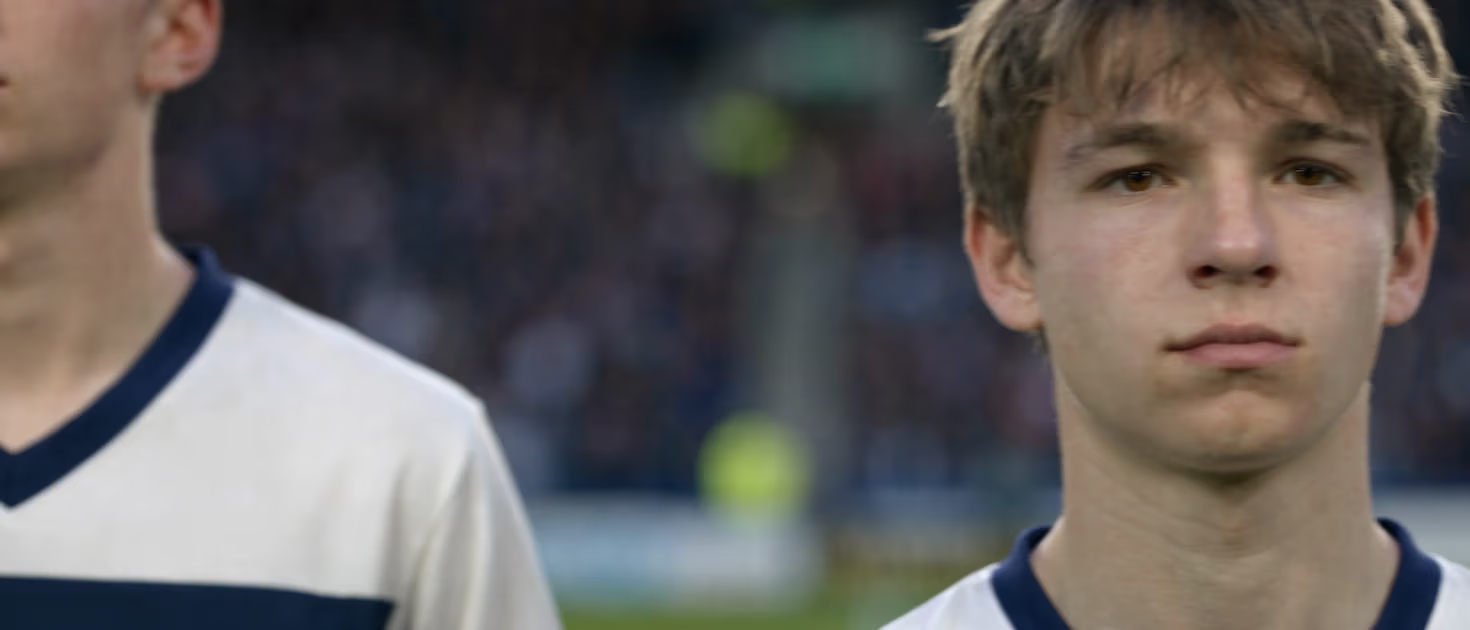
Edit Video1 as a continuous one-take sequence. Preserve the original camera path, timing, shot sizes, composition, pacing, lighting, the seamless transition through the television screen, the pub action, and all picture-in-picture content. Replace only the two principal characters: replace both the young player at the stadium and the adult man in the pub with the same person shown in Image1. Use the portrait, full-body front view, and rear view in Image1 to keep the character identity, facial features, hairstyle, outfit colors, and overall appearance consistent throughout; keep all other people unchanged. Begin moments before kickoff at a football stadium in 2026. The young player stands in a line with his teammates at the far right of the frame. Move the camera horizontally from right to left, first framing a bust close-up of the young player. At three seconds, pull back without revealing the faces of the adjacent players. Continue seamlessly through the television screen without cutting. The television hangs from the ceiling of a pub. Keep pulling back slowly while descending toward the bar, where many people in ordinary clothing, not football kits, watch the television and talk excitedly in a noisy but cheerful atmosphere. A server passes directly in front of the lens. As the server clears frame, reveal the adult man frontally as he walks toward the bar and sits down with calm elegance. Nearby patrons greet him warmly; he acknowledges them and turns toward the television. Move behind him into a low-angle view that includes both the seated man and the footballer on the television broadcast, then continue rotating into a composed side profile of the man watching quietly. Do not show any logos, national flags, club badges, sponsor marks, captions, watermarks, subtitles, or other text. Use no commentary, narration, voice-over, or music; retain environmental sound only. Maintain a modern Chester setting, a nighttime pub interior, and cinematic visual quality.
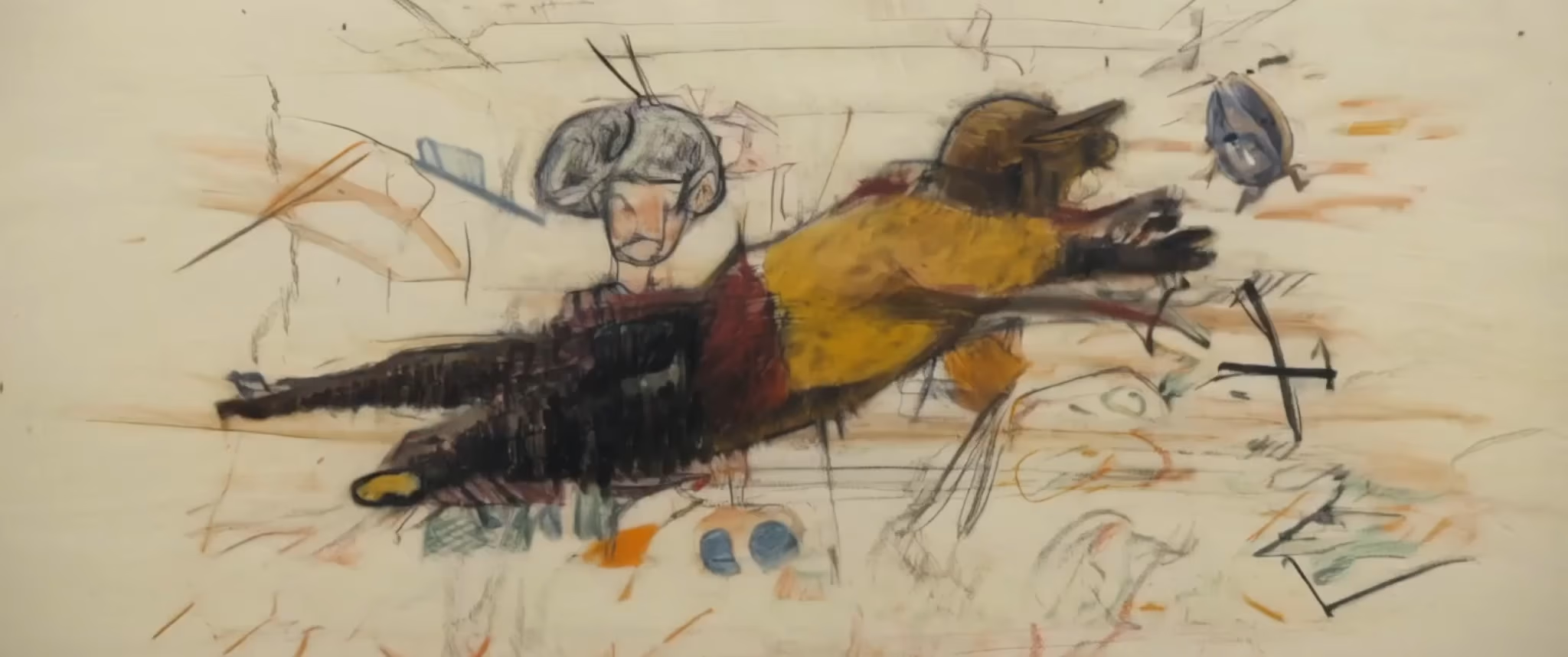
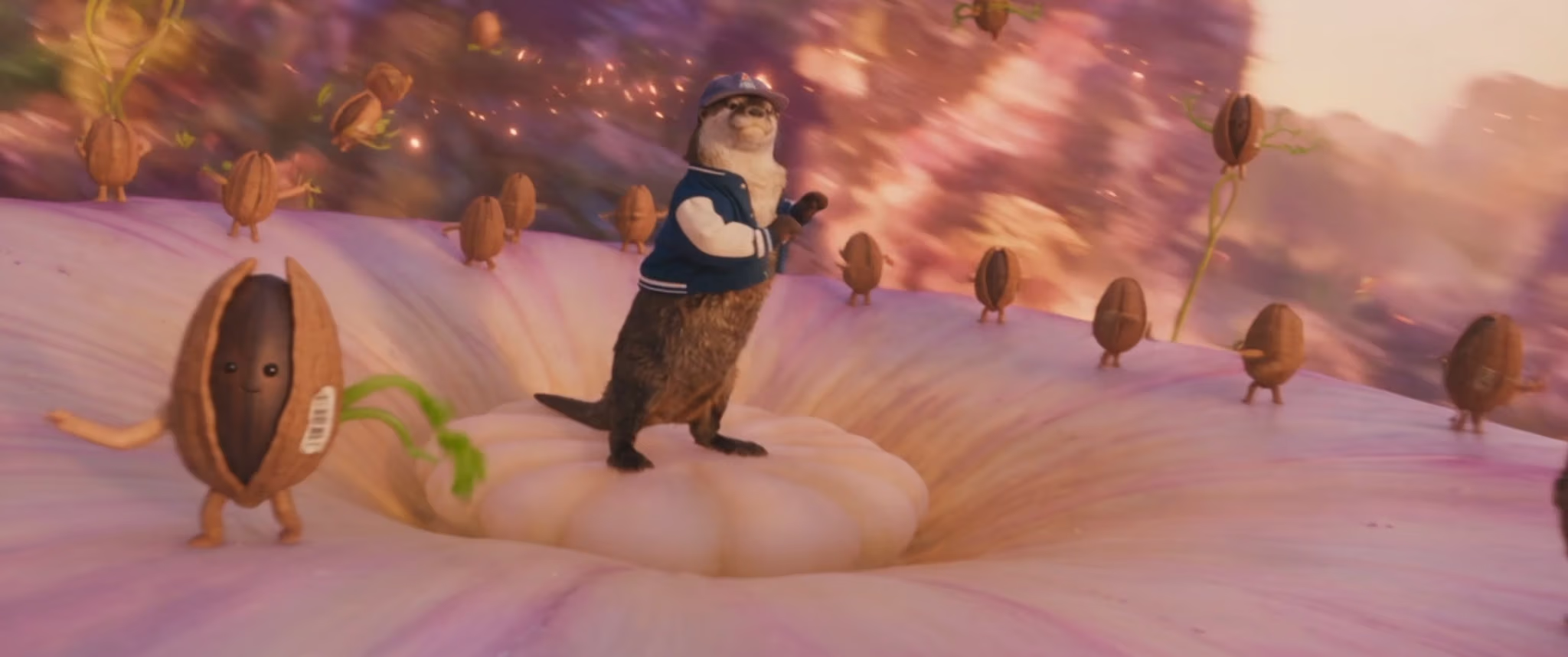
Animación con nutria protagonista. Duración: 3:21. Generada con Seedance 2.5. This content is generated by AI.
Open Source Lens — 10 clips con prompts
Clip 01 00:04 - 00:07
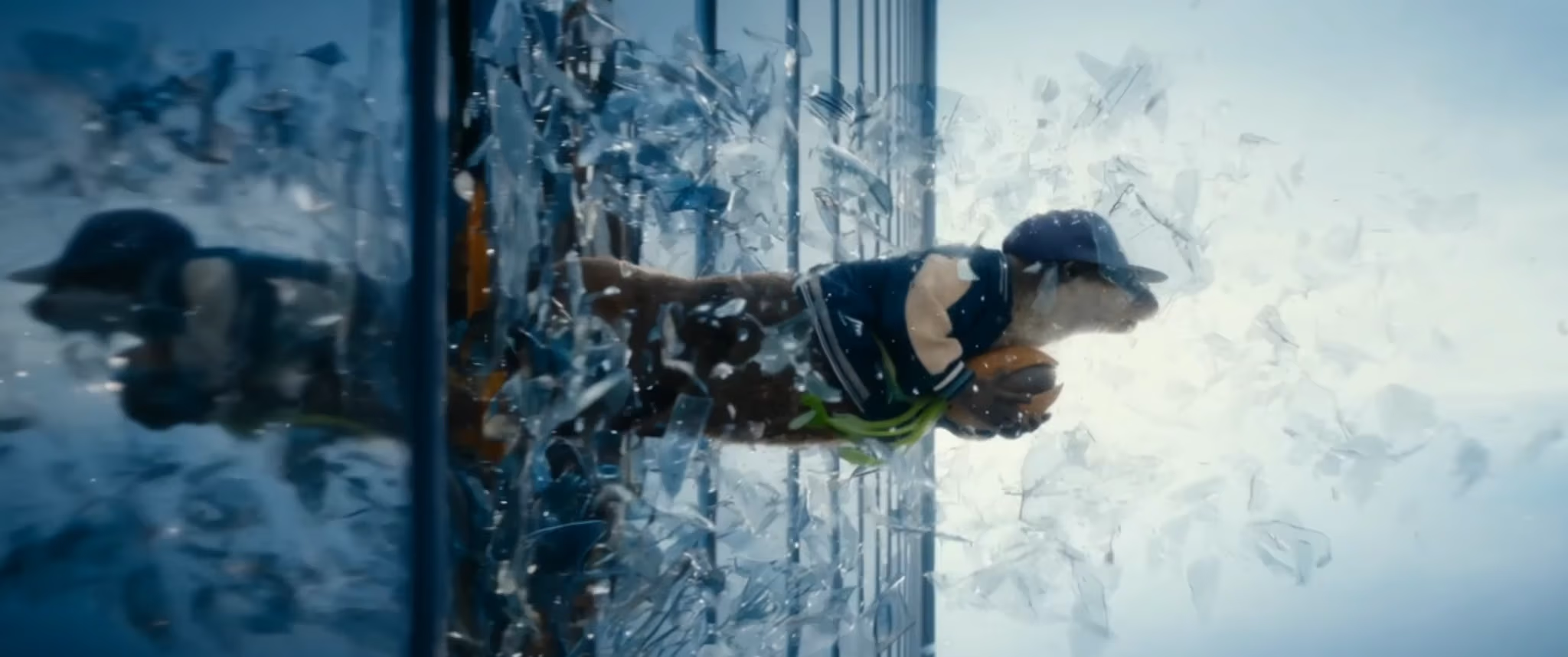
Overall, the film should have a photorealistic live-action cinematic sci-fi look with a faux-documentary / caught-on-camera sense of immediacy, shot with an IMAX large-format aesthetic, anamorphic widescreen lenses, a 180° shutter, and fine film grain. The entire film is a multi-shot montage connect...
Overall, the film should have a photorealistic live-action cinematic sci-fi look with a faux-documentary / caught-on-camera sense of immediacy, shot with an IMAX large-format aesthetic, anamorphic widescreen lenses, a 180° shutter, and fine film grain. The entire film is a multi-shot montage connected only by hard cuts. The image must remain full-width 21:9 throughout—no 4:3 framing, no added black bars, and no retro LCD-style gimmicks. A few shots may intentionally stutter or drop frames, advancing in a stop-motion-like, frame-by-frame rhythm. The color palette is approximately 60% desaturated cool gray concrete and glass, 30% pale blue sky and hazy air with restrained cinematic cool-blue toning—never an overly saturated blue wash—and the remaining 10% is reserved for the giant flower’s gradient from deep red to pink-white. White balance leans cool and slightly blue. The entire film takes place in broad daylight with natural high-key lighting, clear and airy, never a night scene.
Camera movement is strongly handheld in a documentary style: ground-level shots shake noticeably and feel weighted, with visible focus hunting and rack-focus breathing; aerial and helicopter shots glide with a slight drifting instability; the intentional dropped-frame shots move forward in small stop-motion-like jumps. The film is a collage of contrasting angles—grand atmospheric extreme wides cut rapidly against close, intimate handheld moments and stuttering time-lapse-like inserts.
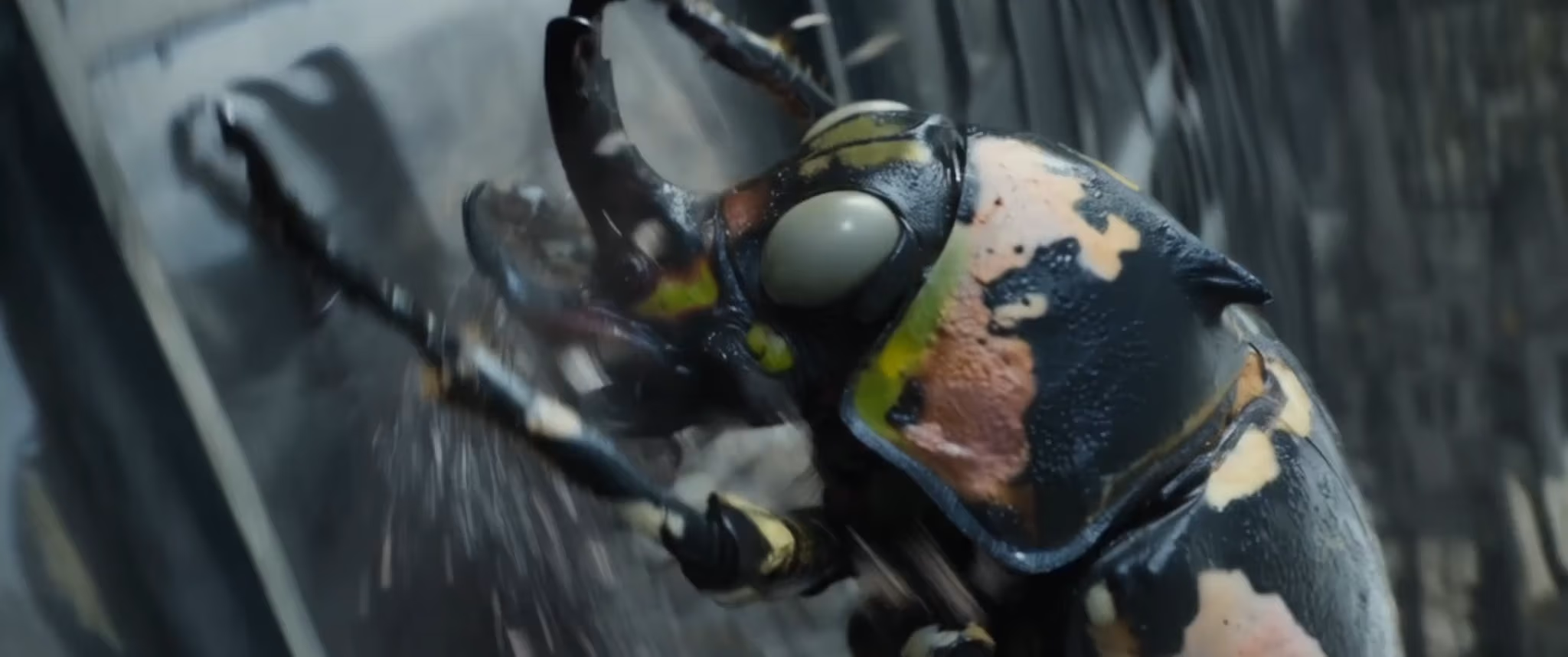
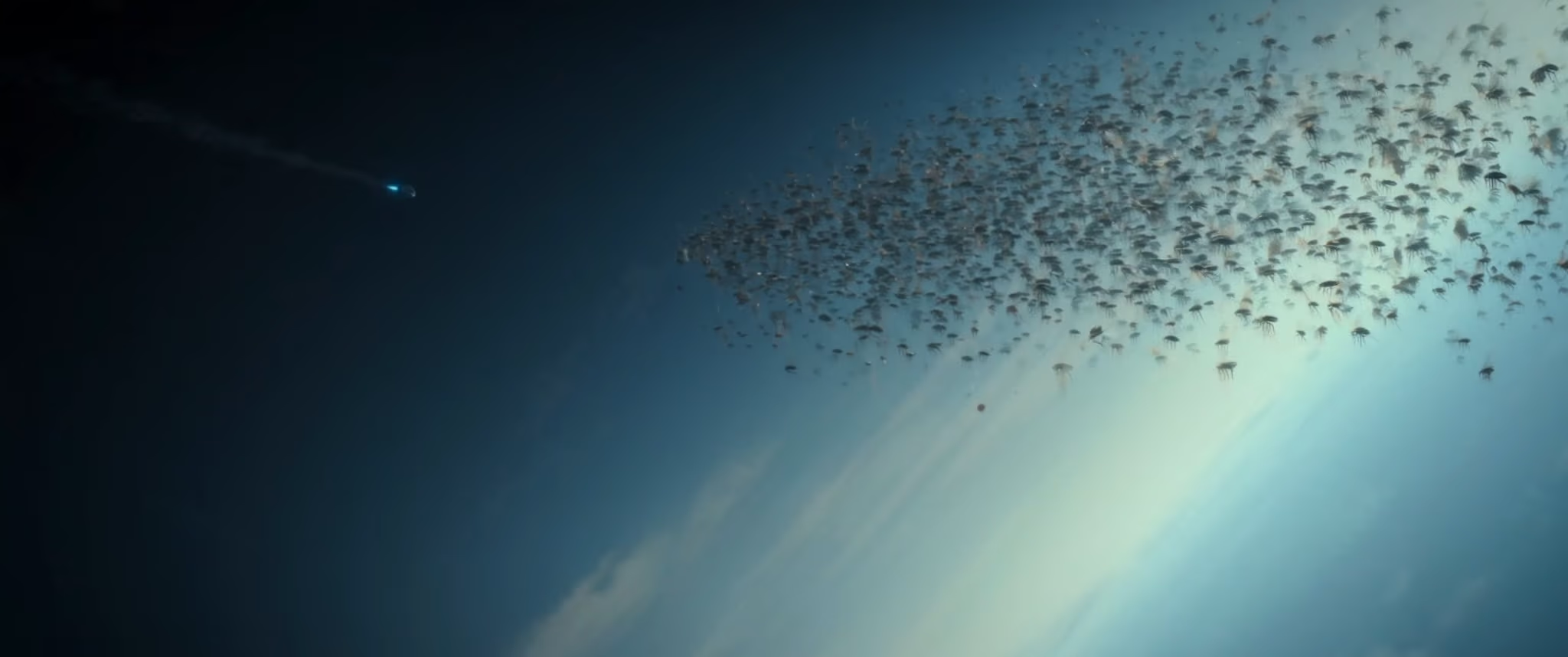
Required elements: the sky is filled with swarms of colossal flying insects, each roughly two stories tall—giant beetles Image1, mantises Image3, and winged insects Image2—with buzzing wings, dozens of them crowding the sky and chewing into skyscrapers. Three to four two-story-tall giant insects crawl across each building and devour the structures. One giant insect suddenly explodes outward through a skyscraper window, blasting glass shards outward. Far below, tiny groups of people flee through ruined streets in the opposite direction of the camera, small, anonymous, and terrified. Most importantly, there is a colossal sky flower matching Image4—tulip / lantern-shaped, with longitudinal ribbed folds, deep red at the top fading downward through pink-white into white, and a pale green stem disappearing upward into the sky. It should stand far away on the skyline in nearly every shot—small in the frame, its upper section obscured by mist and clouds, only partially visible, slowly rotating and twisting while the petals rhythmically contract and expand. It must match the reference image 100%. The city is a generic contemporary city with no recognizable landmarks or national identity, composed entirely of ordinary glass-curtain-wall towers.
Approximate timeline: 0–3s, a high-angle shot looking downward. A building occupies the foreground while the distant giant flower on the skyline is out of focus. A giant insect suddenly bursts out of a lower window, blasting glass outward, and focus snaps violently from the distant flower to the erupting insect. 3–5s, hard cut to a drifting oblique aerial extreme wide: swarms of insects fill the hazy sky while the flower stands at the far horizon, its top disappearing into cloud. 5–7s, handheld close tracking of a giant insect chewing into a building; through a gap between towers, the distant flower is briefly visible. 7–9s, a helicopter hovers directly above the flower and looks down into it—this is the only shot in the film where the flower is close, and the only shot from above into its interior. The flower’s center is a bottomless, pure-black throat like a black hole. No other shot may reveal the flower’s interior or center. 9–12s, an extremely low-angle street shot looking upward, towers closing overhead, insect swarms circling, and the distant flower visible through the gap between buildings, with its upper half blurred into mist and cloud. 12–15s, a very low eye-level extreme wide: the camera sits close to a rooftop and looks horizontally across a vast open city. The horizon must be level, not top-down. At the farthest edge of the skyline, the flower is extremely distant and tiny, seen only as the outer silhouette of its back-facing form. Its petal interior and center must not be visible. The upper half remains partly submerged in haze and cloud as it slowly rotates, contracts, and expands, while insect swarms drift through the sky.
Hard constraints: the entire film must remain in broad daylight with no night or dark scenes. Except for the single helicopter shot, the flower’s interior / center must never be visible. The final shot must be a level, horizontal horizon shot—not a top-down angle—and may show only the flower’s exterior silhouette. In all other shots, the flower remains distant in the background and must never be placed close to camera or in the foreground. The flower’s top must never be sharply visible. No recognizable landmarks, famous buildings, national skylines, signs, flags, or national identifiers. No aircraft except in the single helicopter shot. Fleeing humans must remain distant, anonymous, and never shown in close-up. No subtitles or logos. Blue must remain restrained and cinematic, never an intensely saturated blue wash. The flower is truly colossal in real-world scale; it only appears small because it is extremely far away.
Sound: no music and no dialogue, only environmental sound—the mass buzzing of wings, giant mandibles chewing concrete and glass, explosive window shattering, falling debris, low desolate wind, distant panicked crowds and running footsteps, helicopter rotor noise during the helicopter shot, and muffled interior ambience when heard through windows.
Clip 02 00:19 - 00:25
Overall, the film should present an 8K IMAX cinematic look with fully photorealistic live-action realism. It must follow a practical live-action photography route and avoid the appearance of 3D rendering, game engines, or game-cinematic CG. Creatures must have realistically wet fur, iridescent physi...
Overall, the film should present an 8K IMAX cinematic look with fully photorealistic live-action realism. It must follow a practical live-action photography route and avoid the appearance of 3D rendering, game engines, or game-cinematic CG. Creatures must have realistically wet fur, iridescent physical shells, convincing deformation of stressed metal, and tactile dust and particles. The overall tone combines deadpan comedy with large-scale spectacle—credible, absurd in an everyday way, and never exaggerated like a cartoon.
Photography should be naturalistic and masterfully cinematic, using ultra-wide IMAX composition and multiple shots. Every camera move must be motivated, with rack focus used to advance the narrative and clean hard cuts used between shots. The pacing is calm and restrained, with dark humor: a gigantic beetle works earnestly in the background, laboriously crushing a city bus into a ball, while a small otter quietly sneaks through the foreground. Tension and absurdity coexist. Use real cinema lenses and ultra-wide anamorphic framing, with 180° shutter motion blur, subtle film grain, grounded handheld micro-movement, and repeated focus pulls between foreground and background. Everything runs at real-time speed with no slow motion. Lighting is hard natural daylight, with overcast skies breaking toward sun and daylight flooding into an urban canyon split open by colossal tree roots. Cool-gray concrete and glass, soft ambient bounce in shadow, and faint dusty haze carry the light. The image must remain bright, transparent, readable, and clean. The environment references Image3.
Color ratio 60:30:10: 60% cool-gray concrete, glass towers, and pale sky; 30% warm-brown giant roots and the otter’s fur; 10% vivid yellow bus and the beetle’s shifting iridescent shell as accents.
Physics must strictly follow real gravity, mass, and inertia. The giant beetle pushes with enormous body weight. As the yellow bus is shaped into a sphere, the metal bends and curls convincingly, windows deform, and body panels fold layer over layer. The small otter moves lightly and carefully, balancing itself and tiptoeing in a comically cautious way. Dust and fragments scatter naturally.
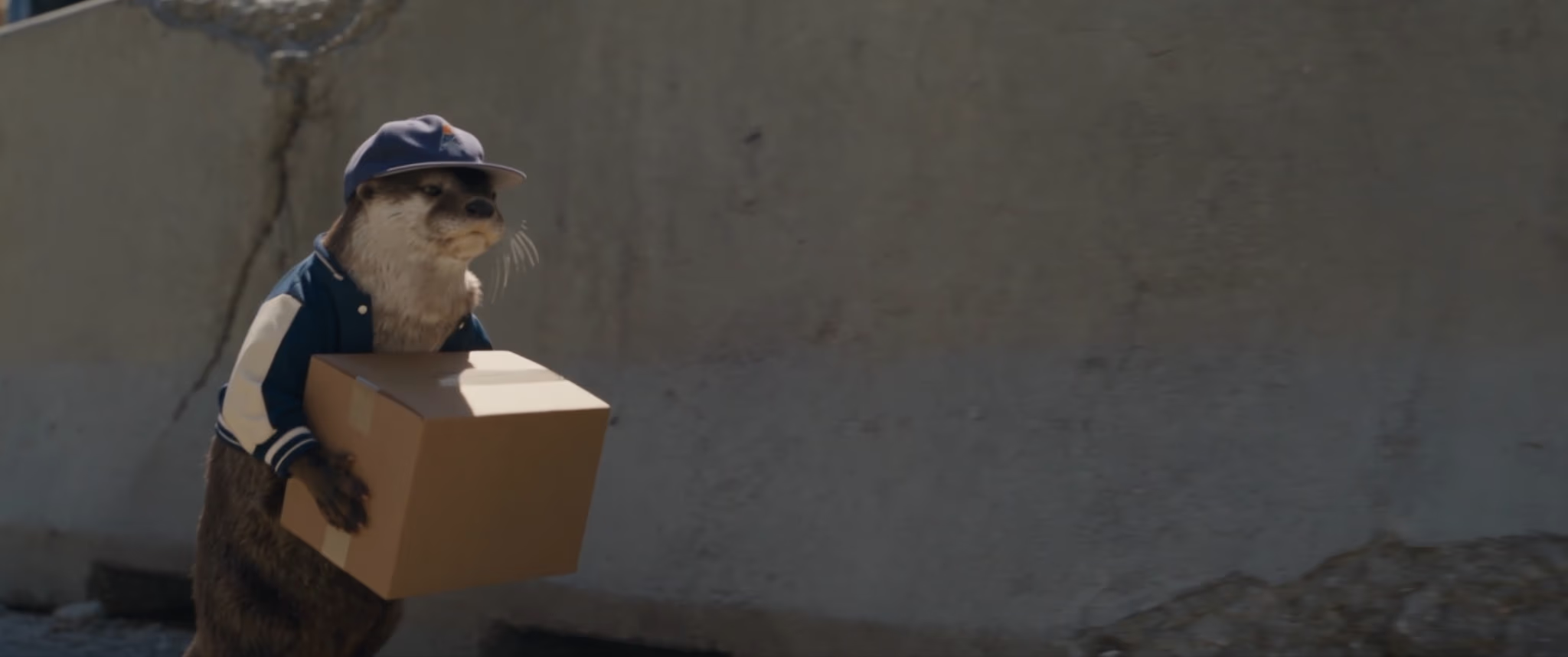
Characters must match the reference images 100% and remain stable across all shots without visual drift. Image1 is the courier otter: a small upright river otter with dark wet fur, wearing a navy-and-cream varsity jacket with an orange logo patch and a navy courier cap, tightly hugging a cardboard parcel. Its expression is exhausted, alert, and comically cautious. It is the film’s only protagonist. Image2 is the giant beetle: a building-sized rhinoceros beetle, with glossy blue-black color-shifting iridescent shell, an enormous curved horn, and thick spiked legs. It is completely focused on slowly rolling the bus into a ball and never notices the otter. It must match the reference 100%. Image2 is the yellow city bus: an old bright-yellow city bus being slowly crushed and rolled by the beetle into an almost perfect sphere. Body panels bend, windows deform, and eventually the entire vehicle compresses into a flawless yellow ball. The location is an urban street canyon overtaken by giant spreading tree roots. Cool-gray concrete and glass towers are split apart and pierced by enormous brown roots. Rubble covers the street while bright daylight pours through the canyon, creating a quiet and surreal spectacle.
The film uses multiple shots connected only by hard cuts, with a total runtime of 30 seconds in 21:9 ultra-wide IMAX framing, all at real-time speed. Approximate breakdown: 0–6s, IMAX extreme-wide establishing shot. In cold daylight, an urban canyon has been torn apart by gigantic roots growing through buildings. The small otter crosses a rubble-covered street in medium scale while carrying the parcel, exhausted and alert as it navigates the empty city reclaimed by nature. After passing a broken wall, it suddenly freezes in shock. Hard cut. 6–12s, medium shot of the otter. It sharply turns its head toward frame right, eyes widening. Focus pulls from the otter’s face into the deep background on the rear-right, revealing a bright-yellow bus being slowly pushed and shaped by the giant beetle, metal folding layer by layer. Hard cut. 12–18s, wide shot fully revealing the absurd spectacle: the giant beetle strains earnestly as it compresses the yellow bus, bending panels and deforming windows until the vehicle becomes a rough sphere. The beetle is fully concentrated and completely unaware of its surroundings, creating a serious yet bizarre image. Hard cut. 18–24s, diagonal reverse-angle with deep focus: in the foreground, the giant beetle slowly rolls the half-formed bus sphere with intimidating scale; in the background, the small otter peeks from behind a broken wall. Focus shifts from the foreground beetle to the background otter as the otter realizes it has not been noticed. Hard cut. 24–30s, wide-lens tracking shot for the comedic escape: the otter crosses the open street with absurdly exaggerated but cautious tiptoe steps, carrying the parcel as it quietly slips behind the oblivious beetle. In the far background, the beetle gives one final push, completing the bus as a perfectly smooth yellow sphere. The otter hurries away, tiny and free. The tone remains cool, deadpan, and absurd. End.
Constraints: use 21:9 ultra-wide IMAX framing. Hard cuts only, no dissolves. Real-time speed only, no slow motion. The identities and designs of the otter, beetle, and bus must remain consistent across every shot, with no drift, duplicates, or prop changes. The beetle remains oblivious throughout; the otter remains comically cautious. The tone is calm, restrained, tense, absurd deadpan comedy combined with giant-scale spectacle. Lighting is naturally bright daytime, highly readable and transparent. Fully photorealistic throughout. No subtitles, screen text, logos, or watermarks. No dialogue and no music.
Sound is location sound only, with no music: cold wind moving through the empty urban canyon and hollow abandoned interior ambience; deep metallic groaning and creaking as the bus folds and curls, with small glass fractures; heavy scraping of the beetle’s shell and strained pushing sounds; tiny light tiptoe scrapes from the otter and nervous shallow breathing. The emptiness itself should feel comedic, using quietness to support both tension and absurdity.
Clip 03 00:32 - 00:47
Overall, the film should have an 8K photorealistic live-action and documentary-grade look. The animals can speak, with anatomically realistic fur and feathers. Avoid any 3D, game, or anime appearance. Every design must strictly match the reference images.
The overall feeling is a Top Gun-style aeri...
Overall, the film should have an 8K photorealistic live-action and documentary-grade look. The animals can speak, with anatomically realistic fur and feathers. Avoid any 3D, game, or anime appearance. Every design must strictly match the reference images.
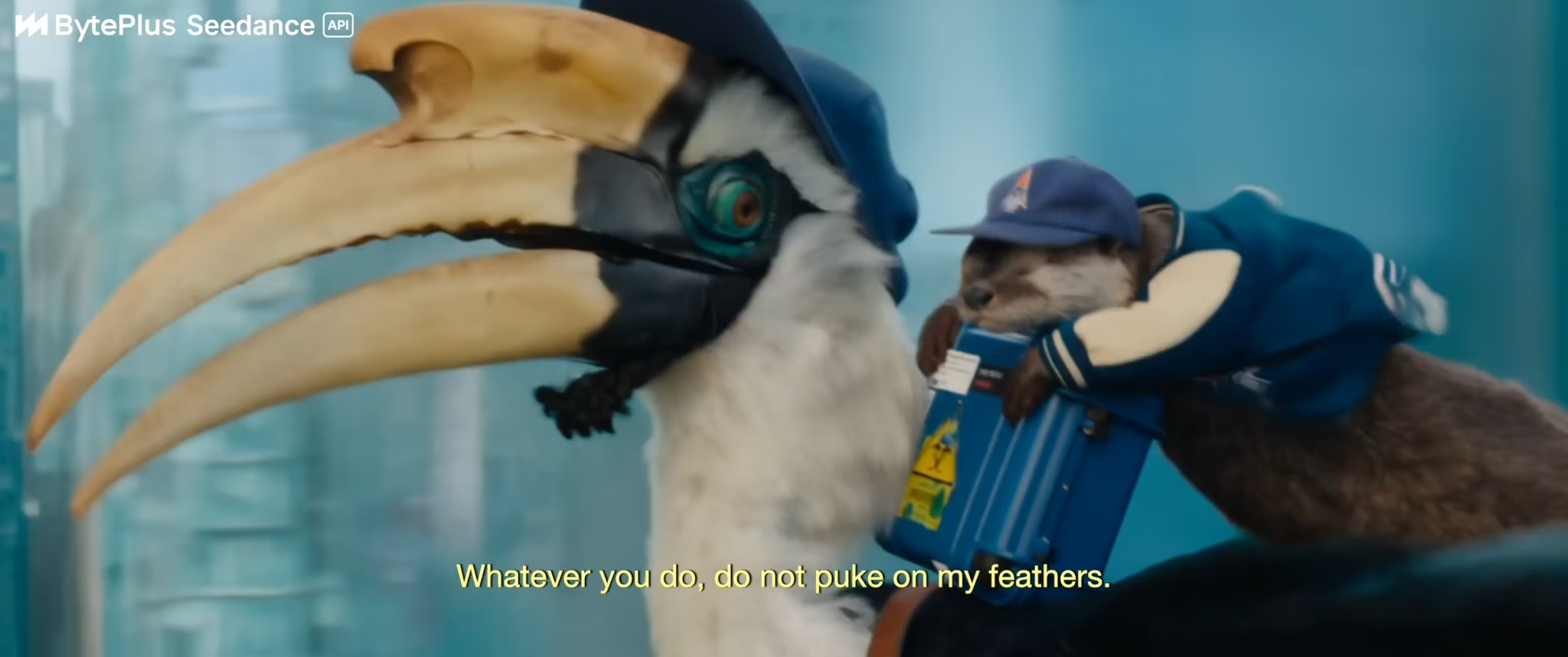
The overall feeling is a Top Gun-style aerial dogfight through a teal glass-tower city Image4—extremely fast, composed of many short shots, hard cuts only, and no slow motion. From the first frame to the last, everything remains at full speed, including dialogue delivery. The film should feel like a fragment taken from the middle of an ongoing dogfight, with no calm opening and no ending resolution. Shoot flying sequences with wide anamorphic lenses in the 14–24mm range and otter close-ups with a 50mm lens, using 180° motion blur, heavy grain, violent handheld shaking, and extreme speed smearing as towers whip past. Aspect ratio: 21:9.
Color ratio 60:30:10: 60% teal-toned city, 30% the hornbill’s black-and-white feathers plus the otter’s navy jacket and brown fur, and 10% cream-colored casque, sunlight reflections, and the beetles’ black shells with cream markings and pale eyes. Physically, the hornbill is small and exceptionally agile, turning sharply like a fighter jet and snapping between towers. Its feathers, the otter’s jacket, and the brim of the cap are violently blown by the wind throughout. The beetles are enormous, at least twice the hornbill’s wingspan, creating strong pressure and threat. They fly fast in straight lines but have wide, slow turns. When the hornbill flashes through a narrow gap at the last possible moment, the beetles are too large and slow to correct and crash directly into glass. The hornbill itself must never collide with anything.
Character setup: Image1 is the otter, wearing a navy varsity jacket with cream sleeves and a navy cap, tightly hugging a blue biohazard case, eyes closed throughout, riding high on the hornbill’s back, matching Image1. Image2 is the hornbill, white body, black wings, cream casque, wearing a navy cap and satchel, confident and highly agile, matching Image2. Image3 represents three enormous armored beetles with black shells, cream markings, pale bulging eyes, and pincer-like horns. Each must be at least twice the hornbill’s wingspan, match Image3, and appear at a giant scale.
The film contains eleven shots over a total of 30 seconds, all at full speed. S1, 0–3s, hero chase shot: the hornbill slices between two towers, the otter riding on its back with eyes tightly shut, while three huge beetles fill the sky behind and close in. S2, 3–6s, hornbill side close-up (50mm): it glances back at the beetles, then at the otter, with sharp controlled movement. Dialogue: “Whatever you do — do NOT puke on my feathers.” S3, 6–8s, otter side close-up (50mm): it did not hear clearly, eyes still shut, and has not started screaming yet Audio1. Dialogue: “Wait— what did you just s—” cut off mid-word. S4, 8–11s, hero shot: exactly on that interrupted syllable, the hornbill suddenly folds its wings and dives vertically down the canyon. The otter’s scream erupts here and continues. Glass walls race upward out of frame as the beetles follow the dive. S5, 11–13s, otter POV: the ground rushes closer, then the flight suddenly pulls up into a vertical climb and the horizon flips, with extreme speed smearing at the edges. The otter’s eyes remain shut; screaming continues. S6, 13–15s, side tracking shot aligned with the hornbill: feathers and jacket whip violently, while one huge beetle closes in on the same plane with overwhelming scale. S7, 15–18s, hero dogfight shot: at the last possible instant, the hornbill flashes through an extremely narrow gap between towers. The beetle, too large and too slow to fit, crashes directly into the building facade and explodes through a sheet of glass. The crash must clearly result from the hornbill’s agile evasive maneuver. S8, 18–20s, head-on nose camera: the camera is placed ahead and shoots backward as the hornbill snakes toward lens, feathers streaming, with the screaming otter behind and one enormous beetle in the background. S9, 20–22s, otter POV: a violent turn around a tower; the last beetle’s eye swells huge in reflection, then whips out of frame. S10, 22–25s, beetle chase camera: the camera is mounted behind one giant beetle, its shell and horns filling the foreground while the tiny hornbill snakes far ahead. The beetle’s wide, slow turn causes it to fall behind. S11, 25–30s, final hero chase shot: tightly following the hornbill as it violently twists through the tower canyon, feathers and jacket thrashing, the otter still screaming, with the surviving beetle behind. The film abruptly cuts out mid-flight at full speed.
Constraints: hard cuts only, no dissolves or wipes. No slow motion and no speed ramps. The scream begins only at S4 during the dive and must never appear earlier. The hornbill never crashes by itself—every beetle collision with a building must result from the hornbill’s evasive maneuver forcing the oversized beetle into the structure. Beetles must be at least twice the hornbill’s wingspan. Feathers and the otter’s jacket must whip violently throughout. The otter’s eyes remain closed at all times and it never lets go of the case. Character designs remain consistent across all cuts. No logos, text, or subtitles. Dialogue must be spoken exactly in English.
Audio, no music: roaring wind, heavy wingbeats, low beetle-wing buzzing, explosive glass shattering when beetles hit buildings, screaming close-pass whistles, the otter’s cut-off startled vocalization and continuous scream beginning at the dive, the hornbill’s crisp bird-like speaking voice, and urban air ambience. Dialogue and screams must remain clearly audible above the wind.
Clip 04 01:02 - 01:10
Overall, the film should have an 8K cinematic look with completely photorealistic live-action realism. Avoid 3D rendering, game engines, anime styling, and overly polished plastic gloss. Animal characters must retain naturalistic quadruped / wild-animal forms rather than anthropomorphic human-like p...
Overall, the film should have an 8K cinematic look with completely photorealistic live-action realism. Avoid 3D rendering, game engines, anime styling, and overly polished plastic gloss. Animal characters must retain naturalistic quadruped / wild-animal forms rather than anthropomorphic human-like posture or upright standing. Strictly follow the reference images, preserving realistic animal anatomy and movement. They may only wear the existing equipment shown in the references, such as the hat. Fur, skin, and plant textures must be physically real, captured within a true 35mm film look with heavy grain, subtle halation, and authentic anamorphic optics. The film must remain highly detailed, crisp, and solid at 24fps.
Photography should be naturalistic and masterfully cinematic, using shot / reverse-shot structure to tell a gentle, emotional scene with nuanced performance. Use physical anamorphic lenses in 21:9. The film contains three motivated reverse-angle hard cuts, with deliberately different shot sizes and angles so no adjacent shots look alike. Maintain restrained handheld micro-shake throughout, matching the otter’s injured, breath-held tension. Before the case opens, pacing is extremely slow and suffocatingly tense. Once the seed is revealed, the feeling becomes softer and brighter. Keep constant real-time speed throughout.
Lighting must strictly match Image1: a ruined high-rise office restaurant with cool, low-saturation realistic light. Overcast daylight enters through broken windows at an angle, with dust floating in the air. Pale-green vapor leaking from the case glows by itself and casts an eerie green tint into the cold-gray environment. Once the seed is revealed, a soft natural shaft of light lands gently across the seed and the otter’s face, introducing warmth. The image may be high-contrast but must never crush into dead black; the face must always remain readable. Avoid god rays and artificial lens-glow spots. Color ratio 60:30:10: 60% cold steel-blue-gray restaurant ruins, concrete, and broken furniture; 30% the damaged blue safety case, the otter’s wet brown fur, and dark-blue cap; 10% the seed’s red label, pale-green case vapor, and fresh green sprout. Overall color is low-saturation, cool, and high-contrast, with a small note of warmth entering at the moment the seed appears.
Use physical anamorphic lenses—35–50mm for reverse-angle relationship shots and 50mm for facial close-ups and emotional shots. Lock focus to one focal plane per shot with no in-shot zooming. Add 180° shutter motion blur, heavy film grain, and slight gate weave. Depth of field should be carefully handled, with foreground sharp and background soft in reverse-angle compositions. Constant real-time speed throughout. Physics must strictly obey gravity, weight, and inertia. The otter remains severely injured and extremely weak throughout. Every movement is slow, trembling, and painful. Its limbs shake and can barely support its body weight, and each movement makes it grimace. Opening the case must obey real physical mechanics: the paw first struggles against the stiff latch and pries it loose, then gradually lifts the lid against hinge friction and weight. The lid rises slowly with believable mass and settles with a slight downward bounce. It must never spring open by itself, clip through objects, float, or stutter unnaturally. Green vapor follows real airflow. When the new sprout brushes the otter’s whiskers, the whiskers flex naturally. Fur and leaves react with realistic inertia. No object may float, deform arbitrarily, or clip through another object.
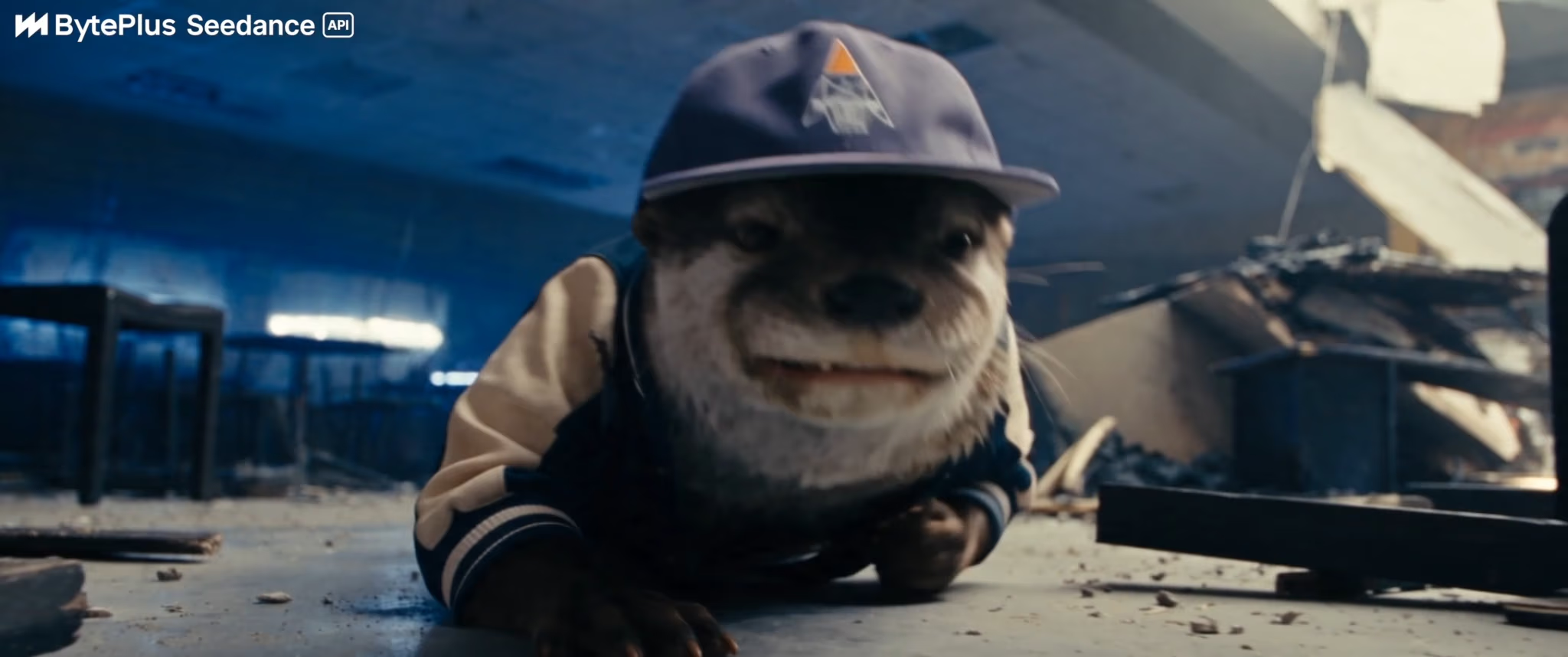
Characters must match the reference images 100% in appearance while remaining fully naturalistic, non-anthropomorphic animal forms. Image2 is the otter, guardian of the seed and a father-like figure. It is a small-clawed otter wearing a cap, moving in a natural quadruped posture. It is kind, self-doubting, extremely gentle, and deeply emotional. At this moment it is badly injured—covered in wounds and mud, bleeding, extremely weak, in constant pain, trembling, breathing shallowly and rapidly, and barely able to support itself. This weak and painful state persists across all three shots. Its only task is to protect the seed. Voice must align with Audio1 and sound gentle and cute. Image3 is the seed, which naturally includes a red label in the same reference image. It is only about the size of the otter’s thumb. The red label is neatly attached to the top of its head, roughly half the size of the seed’s body, and is a fixed part of its design. The seed is extremely cute—round, full, glossy, with large crystalline dew highlights. It trembles shyly and bounces very slightly. It does not speak, only making baby-like coos and whimpers. In this world, it is a child that needs protection and sees the otter as a father. It can extend one tiny green sprout. The red label must remain attached to the top of its head at all times. Image4 is the blue hard-shell safety case, now roughly 70% damaged, lying on its side rather than upright, lid still closed, with pale-green vapor leaking from its seams. It is the key prop of the film. Image1 is the ruined high-rise office restaurant after impact, filled with broken tables and chairs, shattered glass, dust, and angled cold-gray daylight through broken windows. The reference controls only environment and lighting, not camera placement or composition.
Dialogue must appear exactly, with no omissions, in English only, and must lip-sync to Audio1. In the third shot, the otter says in a weak, gentle, cute breathy voice: “A tiny seed? So you're my first customer?”
The film uses three shot / reverse-shot setups with different framing and angles, constant real-time speed, 21:9, total duration approximately 30 seconds, and three shots. Emotional arc: pain and fear → confusion → curiosity → warmth. The otter remains weak and in pain throughout. Shot 1, 0–12s: reverse angle, damaged safety case in the foreground and otter in the background, 35–50mm, slightly low angle. The freshly injured otter painfully drags itself toward the case lying on its side. Its damaged leg trembles and nearly collapses. Every inch hurts, its breathing is sharp and fast, and its face is twisted by worry, tension, fear, and pure physical pain because it believes the case may contain a deadly toxin. It swallows hard, throat moving, gathers courage, takes a trembling breath, and reaches a shaking paw toward the lid. Pale-green vapor continues leaking from the seam as the otter strains to keep its body upright. With eyes half-closed and face turned slightly away, it first struggles with the stiff latch and pries it loose, then gradually lifts the lid against hinge friction and weight. The lid rises slowly with real mass and never pops open by itself. As soon as the lid clears, the otter’s eyes snap wide. The expected poison or horror does not appear. Its pain-worn face freezes for one beat, then slowly shifts into confusion. Hard cut. Shot 2, 12–18s: reverse angle over-the-shoulder, otter’s shoulder / back in foreground, case interior in background, 50mm shallow depth of field. From the otter’s over-the-shoulder view, looking into the case while its shoulder still trembles and its breathing remains weak and painful, there is no toxin—only a tiny adorable seed waiting to sprout, no larger than the otter’s thumb, round, full, glossy, with big dew highlights and a red label neatly attached to its head. The seed gives a small fragile tremble and tiny bounce, making an extremely cute baby-like coo. The otter’s confusion softens into curiosity, while it remains sore and weak. Hard cut. Shot 3, 18–30s: reverse angle, the seed’s body and sprout in the foreground with the red label still attached, the otter in the background, 50mm shallow depth of field, gentle finish. The otter remains weak and in pain, shoulders slumped and breathing shallowly. It studies the little creature with curiosity and tenderness, then softly says in a gentle, cute, weak breathy voice Audio1: “A tiny seed? So you're my first customer?” After the line, the seed extends a tiny tender sprout and shyly brushes the otter’s whiskers on both cheeks, making an “eeee-eeee” pleading baby-like sound while trembling cutely. The otter is quietly moved by this gentle signal, accepting the seed with family-like affection. Its painful gaze softens, and a sincere, warm, exhausted smile slowly forms. Hold on this warmth. End.
Constraints: 21:9 anamorphic widescreen. All characters, props, and environment must match the reference images 100%. Animals remain natural quadruped / wild-animal forms, not anthropomorphic or upright, wearing only their existing equipment. The otter must remain badly injured, weak, trembling, and in pain across all three shots—never healthy, energetic, or cleanly athletic. The seed is thumb-sized, extremely round, glossy, and cute. It does not speak, only baby-like coos and whimpers. It can extend a small sprout. The red label is a fixed design element and must remain attached to the top of its head, matching the reference 100%, never disappearing or falling off. The case is about 70% damaged, lying on its side, not upright, with pale-green vapor leaking from the seam. Case opening must obey real mechanics: loosen the latch first, then lift the lid gradually with realistic weight and hinge friction, with a slight settling bounce. The lid never springs open by itself, clips, floats, or jumps. The shot / reverse-shot structure must be fully maintained with three hard cuts, and every adjacent shot must differ clearly in shot size and angle. Hard cuts only, no dissolves or wipes. Reverse-angle shots must stay on the same axis without crossing the line. The left-right relationship between otter and case / seed must remain stable. Emotional arc is pain and fear → confusion → curiosity → warmth, restrained and realistic rather than exaggerated. Each shot locks to one focus plane with no in-shot zoom. Constant real-time speed, no slow motion or speed changes. Photorealistic 35mm film look, extremely high detail, film grain, naturalism. Fur, skin, and plants must be real, never cartoon, 3D-rendered, or game-cinematic. The face must always remain readable, never crushed to black. Identities, appearance, and props remain stable across cuts, with no drift or clipping. This sequence contains no seed escape. End on the otter’s smile. Characters are original non-IP designs. No logos, watermarks, subtitles, or screen text. Dialogue is English only, never Chinese. Absolutely no music.
Sound: no music, only production sound. Voice: the otter’s voice aligns with Audio1 and appears only in the third shot, speaking the single English line in a weak breathy voice. The seed does not speak, only producing baby-like coos and “eeee-eeee” pleading sounds as nonverbal vocalizations. Shot 1: heavy weak rapid breathing from the otter, painful grunts with each movement, swallowing, the stiff latch being pried loose, hinge friction as the lid is lifted, the soft sound of the lid settling, faint hissing from the green vapor, and ruined-environment ambience such as distant dripping water, occasional tiny glass chimes, and cold wind through broken windows. Shot 2: baby-like seed coo and a small painful surprised inhale from the otter. Shot 3: the otter’s gentle weak English line, the tiny rustle of the sprout brushing whiskers, the seed’s “eeee-eeee” sound, and the otter’s strained but moved breathing. All dialogue is English. No music.
Clip 05 01:12 - 01:23
Overall, the film should present an 8K cinematic, photorealistic live-action VFX look with real materials, physical cinema lenses, 35mm film grain, and naturalism. The seed and otter are photorealistic CG protagonists composited into a real ruined kitchen. Avoid any obvious 3D-rendered look, game-en...
Overall, the film should present an 8K cinematic, photorealistic live-action VFX look with real materials, physical cinema lenses, 35mm film grain, and naturalism. The seed and otter are photorealistic CG protagonists composited into a real ruined kitchen. Avoid any obvious 3D-rendered look, game-engine gloss, anime styling, cartoon shading, or comic effects. Every frame must feel completely photorealistic. The tone is a playful adventure comedy with extremely high detail: wood grain on the seed shell and its green sprouts, the otter’s wet fur and jacket fabric, flying kitchen knife, apple, soy sauce bottle, dust, steam, and rubble must all appear sharply rendered.
Photography is naturalistic and masterfully cinematic, depicting a one-direction chase. The otter desperately pursues the escaping seed, always trailing behind it. Each attempt gets closer than the previous one, ending in a pounce that is interrupted every time by an object thrown backward over the seed’s shoulder without looking. The three capture attempts escalate progressively. The film uses multiple shots, motivated hard cuts, and dynamic handheld tracking. Screen direction must remain consistent throughout: the chase always progresses from frame left to frame right. The seed is always ahead on the right; the otter always pursues from the left rear. Both move toward the right at all times. Never cross the axis and never have the two run side by side. Use physical cinema lenses and 21:9 anamorphic widescreen.
Lighting is naturalistic high-contrast interior light. Cool overcast daylight pours through holes in the ceiling of the ruined kitchen Image3, with steel counters and tile surfaces catching faint reflections. Dust and light steam float in the air, deep shadows sit in the corners, and stainless steel produces realistic horizontal anamorphic flares. Color ratio 60:30:10: 60% cool cyan-gray kitchen steel, tiles, and dusty shadows; 30% the seed’s warm-brown shell plus the otter’s brown fur and navy jacket; 10% the seed’s vivid green sprout, the barcode’s white, the red kettle, and amber soy-sauce splashes. Overall color is high-contrast, bright but not dirty, with naturalistic film color throughout.
Use physical wide-to-standard anamorphic lenses in the 28–40mm range, with 180° shutter motion blur and film grain. The camera maintains continuous handheld micro-shake while tracking horizontally with the chase, keeping the escaping seed leading on the right and the otter following on the left. Whip-pan with each thrown object and react quickly to reframe when the otter dodges. Everything plays at real-time speed except for exactly one moment: in Shot 2, the instant the kitchen knife passes the otter’s face enters intentional slow motion, returning to full speed at impact. Physics must obey real gravity, mass, and inertia. Thrown objects follow believable trajectories and rotations: the kitchen knife tumbles handle-first before embedding into the counter, the apple bounces and rolls, and the soy-sauce bottle shatters and sprays dark liquid. The small seed runs ahead with light, frantic momentum, sprouts whipping. The otter is heavier, repeatedly charging forward before being forced to brake, duck, or fall with believable weight. Water in the sink displaces and splashes with real mass.
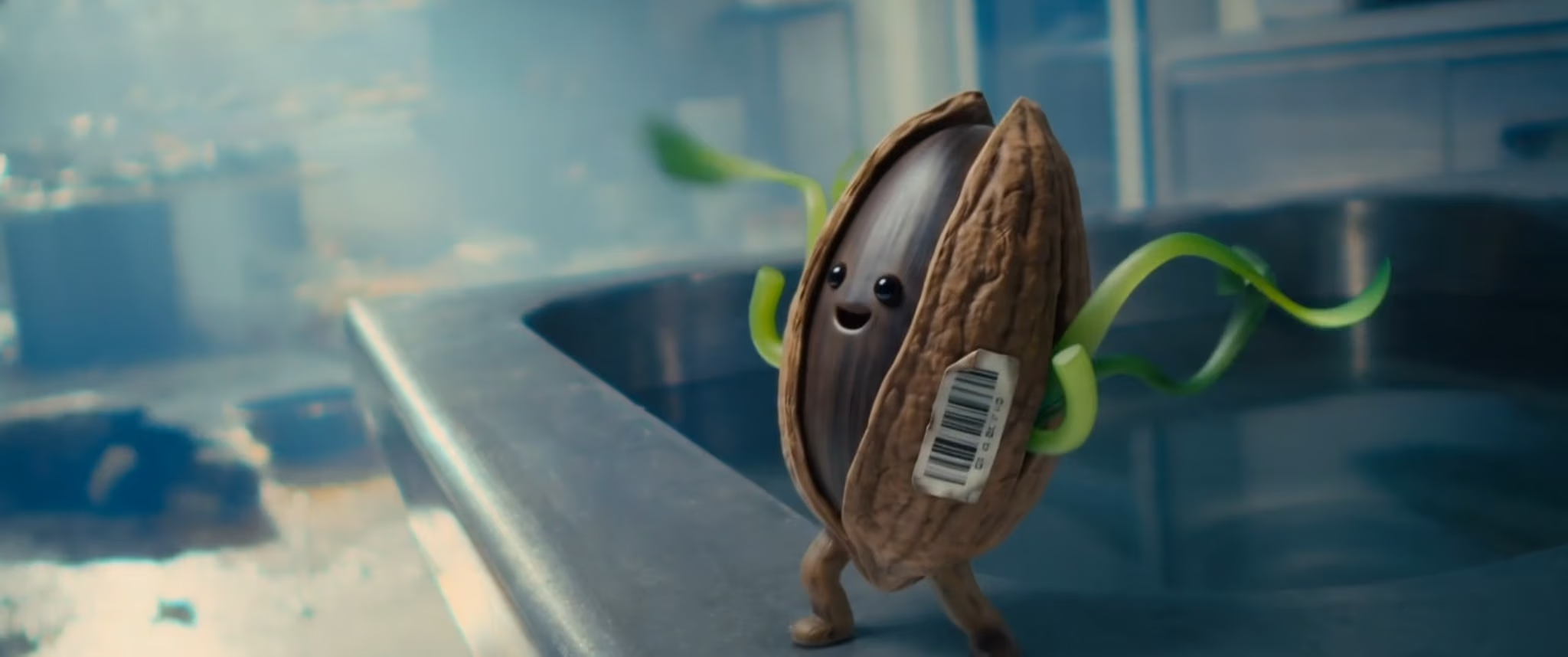
Character setup: Image1 is the otter, the pursuer, always at the left rear. A photorealistic brown otter runs upright on two legs, wearing a navy baseball cap with a small front emblem and a navy varsity jacket with cream sleeves, ribbed collar, and chest patch. Its expression is determined, then increasingly frantic and comically exasperated each time a capture attempt is interrupted. It is agile, matches the reference 100%, and is an original character with no logo or real-world brand. Image2 is the seed, the prey, always at the front-right. It is a small anthropomorphic walnut / pecan-like seed: a dark polished wooden-brown seed body emerging from a cracked light-brown shell as though wearing the shell like a coat, with a minimal face consisting of two dot eyes and a small mouth, 2–3 fresh green sprout leaves trailing behind like a cape, thin brown stick-like legs and little feet, and a white barcode sticker attached to its shell. It is mischievous, smug, and provocative, always running forward while throwing objects backward over its shoulder without looking. It must match the reference 100% and is an original character. The location Image3 is a ruined back kitchen: broken ceiling, hanging foil ventilation ducts, rows of hanging kitchen tools, stainless-steel counters and shelves, a blue bucket, a red kettle, scattered pots and knives, dusty rubble-covered tile floor, and a large stainless-steel sink basin at the far-right end of the counter.
The action is a one-direction comedic chase within a single environment, using hard cuts, 21:9 framing, total runtime 30 seconds, entirely inside the ruined kitchen, progressing left to right. It uses an escalating repeated beat: otter closes in and pounces on the seed, getting closer each time → fleeing seed grabs an object and throws it backward without looking → the object interrupts the capture at the last possible instant → seed regains distance → repeat. No dialogue. Comedy comes entirely from action, facial expression, and physical performance. Shot 1, 0–6s, dynamic handheld left-to-right tracking: seed Image2 runs along the right-side counter while otter Image1 chases tightly from the left rear. First attempt, farthest distance: the otter closes to about half a meter and reaches out, still clearly short of contact. Without stopping, the seed sweeps up a kitchen knife from the counter and throws it backward over its shoulder toward the otter. Shot 2, 6–11s, whip-pan follows the spinning knife. The handle flips as it flies toward the otter’s head. As the blade approaches the face, enter high-frame-rate slow motion for one compact beat: the knife blade passes only millimeters from the otter’s cheek. Fur compresses under the blade’s air wake, whiskers bend, a single sweat droplet hangs in the air, the otter’s eyes widen comically, and the steel edge glides by in razor-sharp detail. Then return to full speed as the knife lands with a “thunk” into a chopping board beside the otter. The otter brakes hard and ducks, its cap knocked crooked. During this opening, the seed pulls farther ahead on the right, and the otter shakes its head and resumes the chase. Shot 3, 11–17s, second attempt, closer: the otter surges forward and pounces, its outstretched paw actually brushing the trailing sprout leaves. Just as the paw begins to close, the still-running seed grabs a red apple from a shelf and throws it backward. The apple hits the otter’s forehead, snapping its head backward mid-pounce and causing it to stumble and miss. The apple bounces away and rolls across the tile. The seed keeps running and regains distance. Shot 4, 17–23s, third attempt, closest: the otter launches its most aggressive charge, both paws almost pinning the seed as its palms close around it. On the final frame, the seed squeezes free, grabs a glass soy-sauce bottle, and throws it backward. The otter dives sideways. The bottle flies into a steel rack and explodes, spraying dark soy sauce across the floor. The otter lands in the slick puddle, feet flying out, slipping and scrambling comically amid the mess while the seed sprints toward the sink at the far right. Shot 5, 23–27s, low-angle tracking: the seed jumps onto the rim of the large stainless-steel sink and wobbles there. The otter is still farther back, slipping and scrambling in the soy sauce. The seed turns back to look at the otter, gives a mischievous little grin, shrugs smugly twice, and its sprouts bounce. Shot 6, 27–30s: the seed turns, jumps with a small “plop” into the sink basin, and disappears below the water surface. The camera quickly pushes closer. The otter finally breaks free, arrives one beat too late, its paw slipping before smacking the sink rim. It leans over and stares at the rippling water in panic and disbelief. End on the otter’s stunned face as it watches the empty, gently rippling sink. Hard cut to black.
Constraints: 21:9 anamorphic widescreen. Every frame must remain fully photorealistic live-action in appearance, with 35mm film grain, 180° shutter motion blur, and authentic cinema lighting. No animation look, 3D-rendered look, game-engine look, cel shading, cartoon shading, comic effects, drawn action lines, halftone dots, silkscreen / pop-art overlays, sound-effect typography, subtitles, explanatory text, screen text, or watermarks. Everything runs at real-time speed except for exactly one slow-motion moment: Shot 2 when the knife passes the otter’s face. Return to full speed at impact. No other slow motion or speed ramp. This is a one-direction chase with consistent screen direction: the otter is always the pursuer at the left rear, the seed always ahead on the right, throwing objects backward over its shoulder without looking. Both always move right. Never run side-by-side. Camera never crosses the axis. Three capture attempts must progressively get closer: half-meter gap → touching the sprouts → almost pinning the seed. Each thrown object must arrive exactly as the otter is about to catch the seed and interrupt the capture. All thrown objects follow real physical arcs. Character identities and costumes remain consistent across every cut: otter’s navy cap and cream-sleeved jacket, seed’s cracked shell, green sprouts, and barcode sticker never drift. Single location only, the ruined kitchen Image3. No restaurant. Original non-IP characters, no logos, no real brands. Comedic tone, no gore.
Audio: no dialogue and no human speech. No music, or at most an extremely low-volume light playful comedic ambience. Primary audio is sound effects only: frantic tiny footsteps from the escaping seed and swishing sprouts, heavier pounding otter pawsteps and jacket rustle, the knife’s whoosh and “thunk” into the board, a low stretched slow-motion whoosh as the blade passes the otter’s face, dull apple impact on the forehead, the soy-sauce bottle shattering, kitchen tools clattering, two tiny smug nonverbal chuckles from the seed, the small splash as it jumps into the water, the otter slipping and smacking the sink rim, dripping water, and ripples in the basin.
Clip 06 01:27 - 01:33
Overall, this is a comedic “style-hopping” chase short titled “MULTIVERSE LUNGE.” Photorealistic live action forms the beginning and end, surrounding a roughly 2.5-second ultra-high-frame-rate slow-motion sequence featuring one complete 360° orbit. The entire film is a single continuous shot, 21:9 w...
Overall, this is a comedic “style-hopping” chase short titled “MULTIVERSE LUNGE.” Photorealistic live action forms the beginning and end, surrounding a roughly 2.5-second ultra-high-frame-rate slow-motion sequence featuring one complete 360° orbit. The entire film is a single continuous shot, 21:9 widescreen, approximately 7.5 seconds long. The central camera mechanism—and the single most important instruction—is this: during the middle slow-motion section, the camera must orbit the two characters for one full complete revolution, an uninterrupted 360° circle that returns all the way to its starting position. It must not be a half-circle, not a 90° or 180° arc, and not a small back-and-forth swing. It must genuinely complete the entire circle and return to the original side-view camera position.
Character identities must remain locked and unchanged in every frame and every art style. The otter is the main character of this design set and must be instantly recognizable: a brown river otter Image1, always wearing a navy baseball cap and a navy varsity jacket with cream sleeves. The blue cap and blue jacket are defining identifiers and must remain clearly visible and correctly colored in every single frame and every medium. Never remove the cap and never alter the blue color. The otter looks determined, hungry, and comically predatory. The seed is an anthropomorphic walnut / pecan-like seed Image2, with a cracked light-brown shell, a small green sprout trailing like a cape, a small barcode sticker on the shell, and two panicked comedic large eyes, running desperately. Both are original non-IP characters. They must remain in the same frame at all times: the otter in its blue cap and blue jacket is always chasing the seed. Never show only the seed by itself.
The location is the interior of the same wrecked, abandoned fast-food restaurant Image3: overturned chairs, fries and cups scattered across the floor, a knocked-over cardboard box, broken floor tiles, and flickering ceiling lights. This exact same store must persist through every visual style. Only the artistic medium / technique changes; the location never changes.
Beat 1, approximately 2.5 seconds, photorealistic live action at normal speed: use hyper-real live-action cinematography with a full-frame cinema camera, shallow depth of field, and natural motion blur. The otter has realistic fur and the seed has a real shell texture. The otter, wearing the blue cap and blue-and-cream jacket, charges after the seed across the restaurant floor, kicking up real fries and dust. The seed is cornered and jumps upward from an overturned cardboard box. The otter kicks off the floor and begins lunging / pouncing upward toward the airborne seed, fangs and claws extended. Side-view composition with fast handheld energy.
Beat 2, approximately 2.5 seconds, ultra-high-frame-rate slow motion with a complete 360° orbit—the core of the film. Exactly as the otter reaches the highest point of its pounce, suspended in midair with claws extended and the seed floating just beyond its reach, the image suddenly enters extreme high-speed slow motion. This is not a freeze-frame. Both characters continue moving, only extremely slowly: the otter’s claws gradually extend, fur and jacket tremble, the seed drifts upward, and fragments and fry crumbs hang in the air while continuing to move. It is continuous fluid slow motion, never a frozen still. At the same time, the camera performs the film’s signature move: one complete, uninterrupted 360° orbit around the pair. It must genuinely rotate all the way around the otter and seed together. Not half a circle, not a 90° / 180° arc, and not a small oscillation. The camera must complete exactly 360° around the pair and return to the original side-view camera position. The pair is the sole moving pivot at the center of the orbit and must remain visible through every degree of rotation. The camera passes continuously through all four quadrants: front → far side at 90° → back at 180° → near side at 270° → back to front at 360°. The orbit is smooth, uniform, exactly one complete circle, lasting the full 2.5 seconds, with the camera in constant motion and never stopping.
During this orbit, the visual style rapidly flashes through approximately 19 distinct handmade media, in a multiverse-style sequence. Each style lasts only one or two frames, about eight styles per second. Each medium must fully cover the whole frame and reconstruct both characters and the entire restaurant using the medium’s own lines, brushwork, and materials. It must not merely be a filter and must not change only the background. In every style, the otter’s blue cap and blue jacket must remain clearly identifiable, and the slow-motion pounce continues smoothly while only the artistic medium changes. Style order: 1. Monet-like Impressionist oil painting, broken color and soft chromatic shadows. 2. Van Gogh-like treatment, thick swirling impasto, cobalt blue against chrome yellow, with the restaurant painted in expressive brushwork rather than a starry-sky motif. 3. American 2D cel animation, bold clean outlines, flat bright color, cartoon squash. 4. Nakamura-style sakuga, faceted volumes, rolling volumetric smoke, jagged shadows, smear frames. 5. Pencil sketch, rough graphite key-animation lines and paper texture. 6. Oil pastel, waxy smeared color. 7. Children’s crayon drawing, thick wax scribbles and naive outlines. 8. Cut-paper collage, layered flat colored paper with rough cut edges. 9. Chinese ink wash, flowing black ink, wet bleeding, xuan-paper negative space. 10. Shadow puppetry, translucent backlit leather silhouettes in amber light. 11. String-marionette theater, carved wooden puppets with strings and painted faces. 12. Serious eerie stop-motion, moody clay puppets, hard lighting, visible fingerprints. 13. Needle felt / wool felt, soft fuzzy fibers visibly present. 14. Ukiyo-e woodblock print, flat color blocks, bold key-line contours, Edo paper texture. 15. Woodcut / linocut, high-contrast black-and-white carved marks. 16. Halftone silkscreen, Ben-Day dots and misregistered CMYK layers. 17. Comic / manga, inked panels, screentone, speed lines. 18. Pixel art, low-resolution 2D sprites, dithered shading, large pixels. 19. 3D CG rendering, smooth polished models, global illumination, subsurface scattering—the only style that is smooth rather than frame-stuttering. Transitions occur by having the next medium repaint / rebuild the entire scene from scratch, flashing in approximately two-frame beats.
Beat 3, approximately 2.5 seconds, return to photorealistic live action. The moment the camera completes the full 360° orbit and lands exactly back at the original side-view position, the medium instantly returns to hyper-real live action and time returns to normal speed. The otter completes its pounce—but misses completely, lunging into empty air because the seed has already passed over its head. The blue-capped otter crashes face-first into a pile of fries and ends up flattened on the floor. The seed lands, gives one smug silent shrug, then continues sprinting out of frame. Real comedic timing, authentic motion blur, and impact dust.
The camera movement is one continuous trajectory: Beat 1 is a real-time handheld chase → Beat 2 is the signature complete 360° orbit, one uninterrupted full circle at constant speed, genuinely covering all four quadrants front → far → back → near → front, orbiting the two characters as one pair while both remain in continuous ultra-slow motion. The pair is the moving center of the orbit, stays visible throughout, and the camera never stops. Start and end positions are exactly the same side-view angle → Beat 3 resumes from that same side-view position for the photorealistic comedic finish.
Constraints: the non-negotiable core is that Beat 2 must complete one entire 360° orbit around both characters, returning to the starting side-view camera position. It must traverse the full 360° and all four quadrants. Never a half-circle, never a 90° / 180° partial arc, never a small back-and-forth motion. Beat 2 is ultra-high-frame-rate slow motion, not a freeze-frame. Both characters move fluidly at extreme slow speed while the camera continues moving without stopping. The camera orbits the two characters together as one paired center, not only one of them. Both the otter and seed remain in frame at every degree. The otter’s iconic design is mandatory in every frame and every art style: the navy baseball cap remains on its head, the navy varsity jacket with cream sleeves stays present, and the blue must remain accurate. Never omit or recolor them. Both characters, otter chasing seed, remain visible in every frame and every medium. Never show only the seed. In every medium, both characters and the store must be fully redrawn in that medium. Never change only the background. The location remains the exact same wrecked fast-food restaurant throughout. Only the medium / brushwork changes, never the location. Seed identity remains consistent: cracked shell, green sprout cape, barcode sticker. Reference composition guides layout only and does not define the style.
Sound: silent-film approach with only diegetic sound effects. Real chase footsteps, slipping, and takeoff air-whoosh. Entering slow motion produces one elongated time-warp whoosh. Style changes produce rapid paper / paint / shutter-click sounds. When normal speed returns, room ambience snaps back abruptly. The otter’s failed pounce lands with a comedic dull thud and a scatter of fries. No music, no score, no dialogue, no human voice, no singing.
Clip 07 01:36 - 01:40
A 30-second 21:9 underwater short film with an 8K, fully photorealistic live-action underwater look, shot through real cinema optics that capture authentic water volume, caustics, turbidity, and suspended matter. Avoid 3D rendering, game-engine visuals, and anime aesthetics. Both protagonists must a...
A 30-second 21:9 underwater short film with an 8K, fully photorealistic live-action underwater look, shot through real cinema optics that capture authentic water volume, caustics, turbidity, and suspended matter. Avoid 3D rendering, game-engine visuals, and anime aesthetics. Both protagonists must appear as real, wet biological creatures. The image uses heavy film grain, 180° shutter motion blur, and anamorphic widescreen. Underwater particles and microbubbles drift through the entire film. Lighting is high-contrast naturalistic underwater light: cold steel blue fills the pipes, while pale shafts descend from overhead grates and wall lamps, forming volumetric beams through sandy water. The fully open fan throat is backlit with a cold glow. The image must remain bright rather than dark and clearly readable. The palette is dominated by cold steel-blue-gray flooded concrete pipes, followed by the otter’s dark-brown fur and navy jacket and the seed’s warm wooden-brown shell, with accents from cold beams, white-blue bubbles, and the seed’s small green sprouts. Physics must strictly follow underwater fluid dynamics: the seed has buoyancy but cannot propel itself and simply tumbles helplessly with the current; the otter is a natural swimmer and cuts through the water at roughly three times the flow speed, wet fur leaving microbubbles; the fan generates a violent vortex pulling everything toward exposed blades; bubbles and sediment respond with realistic buoyancy and drag; the camera is violently buffeted in turbulent flow.
There are only two characters. The seed Image3 is a small anthropomorphic half-walnut-shell figure with a glossy deep-brown wooden shell, thin sprout-like limbs, and two curled green shoots. A barcode is attached to its shell. It cannot swim and can only tumble and struggle. It has no visible sclera. Its eyes have only two possible states: tiny pure-black dots by default, or pure-black X marks. Throughout Shots 1–7, the eyes remain black dots. Curiosity and panic are expressed only through widened trembling black-dot eyes and body movement. The black X marks appear for the first time only in Shot 8 when the seed is near death and losing consciousness. They must never appear earlier. The otter Image2 is a lean upright anthropomorphic river otter with soaked, tangled dark-brown fur, wearing a worn navy-and-cream flight jacket that floats in the water. It is powerful and fast underwater, with strong tail strokes and eyes locked onto the seed, conveying anxious protective determination. Emotion is expressed entirely through face and body, with no dialogue. The environment Image1 is a vast interconnected maze of concrete drainage pipes—crossing tunnels, branch pipes, T-junctions, and intersections extending in all directions. Curved pipe walls show seams and water stains, with sealed or half-open hatches scattered throughout. At one end is a gigantic, fully exposed drainage fan with no grille and no guard. Its bare blades rotate at high speed, creating a lethal vortex. Both characters are original and must match the references 100%, with no logos. The film uses only fast motivated hard cuts and many short shots. Each cut changes shot size or angle so no adjacent shots repeat. The camera remains fully submerged at all times and is pushed by the current. Except for two brief slow-motion moments, everything runs at fast real-time speed with extreme momentum. No camera equipment may appear.
Shot 1, 0:00–0:03, wide low-angle drifting with the current while looking upward: the seed falls from a bright opening above into the pipe network, releasing bubbles, stabilizes itself, and looks curiously around the four blue tunnel directions with black-dot eyes while being rapidly pushed forward. Shot 2, 0:03–0:06, hard cut, medium tracking with the seed: the exposed fan at the far end starts up and its giant blades roar. The vortex instantly pulls sand, bubbles, and the seed toward the open throat. The camera is yanked sideways and dragged violently, shaking hard. The seed’s black-dot eyes widen and tremble while its limbs flail helplessly. Shot 3, 0:06–0:09, hard cut, low over-the-shoulder view from the seed toward the fan throat: exposed blades fill the tunnel with no grille. The vortex pulls the seed inward, black-dot eyes filled with terror. From a branch pipe, the otter cuts at high speed into the main tunnel and sees the danger. Shot 4, 0:09–0:11, hard cut, quick whip-back into a side-by-side tracking shot of the otter: fully streamlined sprint-swim, powerful tail oscillation, wet fur stripping off a sheath of microbubbles, closing the distance at about three times current speed as pipe walls streak by. Violent shaking. Shot 5, 0:11–0:13, hard cut into a short slow-motion moment, camera placed near the fan looking backward: spinning bare blades roar very close in the foreground. The seed is trapped in the center of frame, suspended between the fan and the approaching otter while being dragged toward the blades, black-dot eyes huge and limbs kicking wildly. The otter dives in from deep foreground at full streamline, one arm shooting past camera toward the seed, clamping it at the final instant before blade contact. Spatial order must read fan → seed → otter. The otter dives in from the front of frame to snatch the seed back; it must not already be holding it. Then return to full speed. Shot 6, 0:13–0:15, hard cut, medium two-character shot with violent shake: the otter uses a powerful tail stroke to surge upward and away from the fan, bubbles exploding around them while the blades shriek behind. Motion smear. Shot 7, 0:15–0:17, hard cut, upward tilt: the otter presses the seed to its chest and drives toward an overhead hatch, striking it twice with a paw—clang, clang. The hatch remains locked. The otter’s face tightens and jaw clenches. Shot 8, 0:17–0:20, hard cut, rapid push-in close-up of the seed in the otter’s arms, camera trembling. Now near death, the seed’s eyes change for the first time, flickering quickly between black dots and pure-black X marks. Large amounts of bubbles escape, sprout-limbs go limp, head droops, and consciousness fades. The otter looks down in terror, jaw locking into desperate determination. Shot 9, 0:20–0:22, hard cut, frantic over-the-shoulder pursuit: the otter surges through a T-junction and turns into a branch tunnel. Wall lights flash past while bubbles and sediment tear across camera. Violent shake. Shot 10, 0:22–0:24, hard cut, tight close-up of the unconscious seed: eyes fade into lighter black X marks, bubbles decrease, limbs hang limp, life visibly slipping away as the otter tightens its arm around it. Shot 11, 0:24–0:27, hard cut, chaotic tracking with maximum camera shake: the otter carries the limp seed through confusing intersections and dead ends, checks one sealed hatch, then another, before spotting a loose half-open side hatch leaking faint cold light and surging toward it. Shot 12, 0:27–0:30, hard cut, wide upward tilt that remains inside the pipe: the otter shoulders the loose hatch open and, with one powerful tail stroke, shoots upward with the seed out of the top of frame. Both disappear through the opening. The camera does not follow outside. It stays in the dim pipe watching the open hatch swing while the final escaping bubbles and drifting sediment settle through cold-blue murky water. Never leave the pipe system, never show the exterior. Hard cut to black.
Key constraints: no dialogue. Emotion is conveyed through face, body, and sound design. In the rescue beat, spatial order must clearly read fan → seed → otter, with the otter diving in from the foreground to snatch the seed back. The environment must always read as a complex maze, never as empty or featureless surfaces. Camera never exits the water and never leaves the drainage system. The final shot remains inside the pipe while both characters exit frame. The fan must be enormous, fully exposed, without grille, and its vortex lethal. The seed is caught only at the final possible instant, nearly shredded. The seed has no eye whites. Eyes are only tiny black dots or pure-black X marks. Shots 1–7 use black dots only. X marks appear only beginning in Shot 8. Both characters remain original and consistent across shots, with exactly one seed and one otter, and no prop switching. Color is cool, high-contrast, bright rather than dark, with heavy suspended sediment, debris, and bubble flow. Non-IP. No logos, watermarks, subtitles, or screen text. Stylized danger with no gore.
Sound effects: no music and no dialogue. Only submerged environmental rumble and pipe resonance, hollow rushing water, the giant fan’s deep escalating roar, heavy WHOMP-WHOMP blade impacts, suction-vortex rumble, surging currents and violent drag, smooth WHOOSH sounds from the otter cutting through water, pulsing tail strokes, the hiss of microbubbles through fur, two hard metallic clangs on the hatch, the seed’s weakening bubbling gurgles, creaking and scraping as the loose hatch is forced open, and a final surge of escaping bubbles fading into the low hollow drone of the empty pipe as the swinging hatch comes to rest.
Clip 08 01:40 - 01:57
Overall, the film should have a photorealistic live-action cinematic look, ultra-realistic fur, 35mm film grain, and a cool, transparent blockbuster grade. The pursuit is tense but contrasted with absurd comedy. Runtime approximately 30 seconds. Camera work uses aggressive handheld faux-documentary ...
Overall, the film should have a photorealistic live-action cinematic look, ultra-realistic fur, 35mm film grain, and a cool, transparent blockbuster grade. The pursuit is tense but contrasted with absurd comedy. Runtime approximately 30 seconds. Camera work uses aggressive handheld faux-documentary style: violent shake, frequent whip pans, visible loss and recovery of focus, and unstable caught-on-the-spot framing. Bullet-time / high-frame-rate slow-motion beats, rack focus, push-ins, and slow pull-backs alternate throughout. Use wide anamorphic lenses in the 24–35mm range. Motion blur is extremely strong, with smeared long-shutter trails. The first second must immediately erupt through a window, and the energy remains high throughout.
Lighting and color remain unified across the film: use cool midday high-angle daylight with a cool white balance around 6000–6500K. The sky is cool blue and clear, clouds are cool gray-white, and glass curtain walls reflect a cold-blue skyline. Strong backlight and overexposure are present. Sun and highlights at the top of frame create piercing cold-white clipping, lens flare, and highlight bloom, with strong rim light around subjects. All flares and highlights must be cool white / cool blue. Absolutely no warm gold or orange lighting. Color ratio is 60% mirrored blue-gray, 30% navy on the main subject, and 10% warm orange reserved only for tiny props such as the seed or coffee-cup rim. Absolutely no sunset, golden hour, orange-pink sky, or warm-yellow environmental light.
All insects are gigantic monster-scale creatures, roughly two stories tall or larger, occupying a significant portion of frame with frightening visible detail. Whether crawling on the curtain wall or flying with wings extended, every insect remains a colossal giant. Flying insects must be equally enormous and must never shrink into mosquito-sized dots. When multiple insects appear, they must strictly use Image6—black-brown rhinoceros-beetle type with one large horn and pearlescent compound eyes; Image7—metallic-green stag-beetle type with glowing green markings, giant mandibles, and long spiked legs; and Image8—patterned giant beetle type with pink-olive markings and twin giant jaws. Each must differ in species, shape, horn structure, mouthparts, body proportions, markings, and pose, like mixed species. No locust-like black dots and no cloned identical insects arranged neatly.
Movement direction: the main characters must always run downward along the building’s vertical glass curtain wall. Broken glass and debris fall downward. Wind and motion trails stream upward. Sky remains above and ground below. Never create the impression that they are climbing upward.
Main subjects are strictly bound to references. The otter agent Image1 wears a navy baseball jacket and matching navy baseball cap, which remains securely on its head throughout. Fur is wet. The otter is clever but extremely panicked, running empty-handed, no longer carrying the seed, and escaping side by side with it. The seed Image2 is an anthropomorphic walnut-like seed with fresh green sprouts, tiny hands and feet, an independent character that bursts through the window together with the otter and runs beside it down the glass wall, desperately taking rapid tiny steps while remaining both frightened and cute. The longhorn beetle Image3 has a blue body, extremely long antennae, and translucent wings. It is the first insect to break out from the glass behind the protagonists and begins the chase. Later giant insects must use Image6 / Image7 / Image8 and appear as monster-scale beetles more than two stories tall, smashing through glass walls and attacking. Some crawl on the curtain wall, others fly with wings extended, but flying individuals remain equally enormous. The giant centipede appears only in Shot 5 and is absurdly enormous, as long and thick as the entire skyscraper itself, with dark armored segments and countless sharp legs, emerging through the lower floors and coiling around the entire tower with overwhelming scale. The Malayan tapir boss Image4 wears a brown aviator leather jacket, remains calm, pilots with one hand, and delicately holds a tiny white coffee cup between thumb and index finger with the other while sipping. The spacecraft Image5 is a retro egg-shaped bubble-cockpit vehicle with petroleum-blue paint, cold-white / cyan cabin lights, brown leather seats, and smooth stable flight. The building is the “Juxing Building,” a standard rectangular supertall skyscraper with flat vertical mirror-glass curtain walls, straight edges, regular geometry, and reflections of the cool-blue midday sky. Absolutely no sloped facade, tilted exterior, curved surface, or exotic sculptural architecture. The chase takes place in clear midday conditions, moving downward along the vertical exterior of this rectangular glass tower.
The film contains six shots. Shot 1, 0–11s, one continuous multi-beat break-window long take, beginning with the window explosion on frame zero and not cutting until the boss close-up. At 0:00, the film opens instantly with the window smash. Side camera, lens almost touching the glass. The navy-capped otter Image1 and anthropomorphic seed Image2 violently explode sideways through the window together in panicked motion, bursting out side by side. At the instant of impact, there is a strong backlit bloom: piercing cold-white sunlight blasts from behind the window, filling the lens with flare and clipped highlights. Both otter and seed receive cold-white rim light while shattered glass hangs and scatters through the glow in an extremely brief high-frame-rate slow-motion beat. Immediately after, they land on the vertical curtain wall and run downward side by side in a clumsy panic. The seed’s tiny legs scramble and slip. Camera follows with violent handheld motion. The camera then shifts to a frontal medium shot of the otter as it turns to look behind. At this moment, a gigantic blue longhorn beetle Image3 bursts through the glass below and behind the pair. Composition shows the otter and seed turning in the foreground while the enormous longhorn beetle dominates the midground, almost filling frame with huge body, ultra-long antennae, and translucent wings creating tremendous depth pressure. The otter and seed snap forward and continue downward. Camera shifts into a side-tracking shot of the pair racing down the wall amid extreme chaos—flying glass and the longhorn beetle closing in. During this chaos, the petroleum-blue spacecraft Image5 finally drifts slowly into frame from the upper rear and matches their speed. Inside, the Malayan tapir boss Image4 lounges calmly, piloting one-handed and casually sipping from the tiny white coffee cup. While still sprinting, the otter turns in disbelief toward the late-arriving boss. Panic versus calm creates strong dramatic comedy. Entire sequence is one uninterrupted high-speed take until the first cut to the boss. Shot 2, 11–15s, dialogue rack-focus, first cut. Use deep staging: foreground contains the otter, still capped and looking back at the boss, with the seed beside it in focus; spacecraft is blurred in the background. The boss Image4 lowers the cup and casually says, “Need a hand, kid?” Audio1. Focus shifts to the otter’s stunned reaction in the foreground. Shot 3, 15–19s, colossal insect window breakout with extreme destruction and giant-scale weight. Low camera close to the glass. A monster-sized rhinoceros beetle far taller than two stories Image6 explodes through the nearby vertical curtain wall. A huge section of facade shatters as if detonated. Tons of glass and steel framing burst toward camera and fall. The giant body and horn surge forward and nearly fill the entire frame, creating overwhelming destruction and scale. Shot 4, 19–23s, pull-back reveal with protagonists facing camera. Camera is placed slightly above and in front of the otter and spacecraft. Start medium. The capped otter and seed run toward the camera while still moving downward along the wall, faces turned toward lens. On the left, spacecraft Image5 also faces camera while flying alongside, with boss visible. Camera slowly pulls back, revealing giant green stag-beetle type Image7 and patterned beetle type Image8 chasing in the far background with monstrous pressure. Shot 5, 23–27s, high aerial top-down disaster panorama of the building being destroyed and wrapped by the giant centipede. Use a high-altitude bird’s-eye view, slightly tilted with a subtle Dutch angle. The entire standard rectangular “Juxing Building” is visible and actively being destroyed. Multiple sections of vertical curtain wall explode and collapse, tons of glass and steel falling downward, while monster-scale beetles Image6 / Image7 / Image8 crawl out through separate windows. In the air, groups of winged giant beetles circle and dive. Every one is more than two stories tall and must remain clearly gigantic, never tiny insect dots. Most spectacularly, an ultra-colossal centipede as long and thick as the entire tower bursts through the lower floors, coils upward around the straight building body, and tightly wraps the entire skyscraper. The structure twists and collapses under its pressure. The tiny otter, seed, and spacecraft continue fleeing downward along the vertical wall, dwarfed by the apocalyptic scale. Every giant insect, whether on building, airborne, or centipede, must remain large, distinct, and different in shape, never degrading into dense small dots or clones. Shot 6, 27–30s, look-back push-in to black. The capped otter and seed continue running while looking backward at the insect swarm. Camera rapidly pushes into a close-up of the otter’s wide terrified eyes, cap still securely in place. Hard cut to black.
Constraints: strictly bind appearances to references—otter Image1, seed Image2, longhorn beetle Image3, Malayan tapir boss Image4, spacecraft Image5, chase insects Image6 / Image7 / Image8. Giant centipede appears only in Shot 5, created from text description and matching entire-building scale. Building must remain a standard rectangular tower, “Juxing Building,” with flat vertical mirrored curtain walls and straight edges. No slopes, tilted facades, or curved sculptural surfaces. Characters run downward along the vertical curtain wall. The otter must wear its navy baseball cap throughout every break-window, sprinting, wind, and look-back shot. It never falls off or disappears. Otter and seed are two independent characters that break through the window together and run side by side down the glass. The otter runs empty-handed and never carries or wears the seed. The seed runs on its own legs. Both remain together in frame. Shot 1 must open at 0:00 with the window smash, no static establishing shot or buildup, followed immediately by a strong backlit flare. Shot 1 movement sequence must be: otter and seed burst through window together with backlit bloom → both run downward together → camera turns to frontal medium of otter, which looks back → huge blue longhorn beetle Image3 breaks through glass below / behind them, with foreground otter-and-seed and giant midground insect nearly filling frame → both turn forward and continue down → camera becomes side tracking amid chaos → tapir boss spacecraft Image5 slowly enters and flies alongside, otter turns to look at boss. Entire sequence remains one continuous shot until Shot 2. The first insect breaking out behind them and initiating pursuit must be the giant blue longhorn beetle Image3. Later chase insects use only Image6 / Image7 / Image8 aside from the centipede. Do not confuse them with the longhorn beetle and do not invent other insect types. All flying insects are still monster-scale, more than two stories tall, never mosquito-sized or tiny black dots. Shot 5 must be a slightly tilted high aerial bird’s-eye disaster panorama showing the entire rectangular tower being destroyed, with curtain walls collapsing and structure breaking apart, monster-scale flying insects circling, and one building-sized centipede emerging from the base and coiling around the full tower. All insects remain clearly huge and different in form. Strong handheld faux-documentary style across the film, with violent shaking, whip pans, focus loss and reacquisition, and extreme motion smearing. Shot 2 dialogue may be slightly steadier and Shot 5 aerial may be somewhat steadier but should retain organic breathing movement. Strong backlight and overexposure throughout, but all flare and highlight color remains cool white / cool blue. No warm gold or orange environment light. Characters move downward at all times. Never create an upward-climbing illusion. Window-break shots 1 and 3 must use close-to-glass low-angle or medium framings, never distant tiny subjects. In Shot 4, the otter and spacecraft must face the camera, with camera positioned ahead of them. Dialogue is only the English sentence “Need a hand, kid?” No other subtitles. Photorealistic cinema realism, no cartoon rendering. Absolutely no background score, BGM, music, musical strings, or percussion. Only realistic sound effects and dialogue.
Audio, no score, only effects and dialogue: absolutely no background music, BGM, scoring, musical strings, percussion, or atmospheric music. Only real environmental sounds and character dialogue. Sound includes explosive window breakage, glass shattering and falling, heavy impacts and low-frequency insect snarls as the longhorn and giant beetles burst through walls, curtain-wall steel structures breaking, huge metallic crushing from the centipede wrapping the building, wing-vibration buzz, rapid footsteps including the seed’s tiny steps, roaring wind, low stable spacecraft hum, and a small coffee sip. Dialogue consists only of the boss saying “Need a hand, kid?” The ending cuts abruptly to silence immediately after heavy approaching insect rumble and collapsing facade noise.
Clip 09 02:08 - 02:18
Overall, this should be a realistic cinematic animation short with documentary / live-action texture, film grain, shallow depth of field, and natural motion blur. Absolutely avoid any obvious 3D-rendered look, game-engine look, anime style, or game-cinematic CG aesthetic. Use 21:9 widescreen.
For p...
Overall, this should be a realistic cinematic animation short with documentary / live-action texture, film grain, shallow depth of field, and natural motion blur. Absolutely avoid any obvious 3D-rendered look, game-engine look, anime style, or game-cinematic CG aesthetic. Use 21:9 widescreen.
For photography, use 24mm wide lenses outdoors and 47mm inside the cockpit, with fast focus tracking, natural 180° shutter motion blur, slight anamorphic edge distortion, and fine film grain. Sprint and attack sequences contain heavy high-speed motion blur, whip movement, and strong streak-like speed sensation. Hero moments may use extreme high-frame-rate slow motion.
Lighting takes place at an altitude approaching space. The top of frame opens into deep pure black outer space filled with stars, becoming progressively brighter downward. At the boundary between black space and the white upper atmosphere is a beautiful horizontal glowing blue line, like atmospheric limb glow / the Kármán-line edge. Cold blue exhaust flames from the spacecraft reflect across its body. During descent, the front edges of the spacecraft scrape violently through the atmosphere, producing orange-red friction flames and superheated airflow. Color ratio: 60% cool high-altitude white / pale-gray sky, 30% deep-space black plus the glowing blue atmospheric boundary, and 10% highly saturated focal accents including the spacecraft’s blue exhaust, orange-red friction fire, and the giant flower’s vermilion red.
Atmospheric perspective must be extremely strong, with deep vertical depth and huge separation between three layers. The topmost spacecraft layer is the sharpest and clearest. The middle layer of more than a dozen giant insects is slightly faded into blue-gray haze. The lowest giant flower layer is the most blue, hazy, and low-contrast. Layer upon layer of atmospheric perspective must create a dizzying sense of altitude and depth.
Camera movement must have extreme speed and kinetic force: diving follow shots, orbits, lateral whip pans, first-person sprint / flight views, and multi-angle hard cuts at moments of impact. Include turbulence shake and handheld vibration. Transitions are hard cuts only. Avoid stable, square-on, horizontally centered compositions. Every shot should use a Dutch tilt combined with either high or low angle. Physically, the spacecraft dives at extreme speed with strong inertia and impact force. When it smashes through insects, shells explode apart, fragments scatter, shockwaves expand, insects spin and fall. Thin high-altitude turbulence remains intense. The giant flower continues rhythmically rotating and twisting, contracting and expanding in a curved, organic motion.
Characters are strictly bound to reference images. Image1 is the otter, an upright young male otter courier wearing a navy varsity baseball jacket with cream panels, a rocket emblem on the chest, and a navy cap. He has a youthful, inexperienced feeling. Image3 is the tapir, styled like a WWII U.S. military aviator, wearing a distressed brown leather flight jacket and aviator sunglasses, with the presence of a veteran pilot. The tapir is tall and broad while the otter is only about half its height. Image2 is the seed, a walnut-like seed with cracked shell, matchstick limbs, dot eyes, a green sprout curling from the top, and a barcode sticker attached. Image4 / Image5 is the spacecraft, a retro egg-shaped dark-navy bubble craft with a transparent glass dome. Scale rule is absolute: the spacecraft is extremely tiny. Every insect is four times larger than the spacecraft. Compared with the giant flower, the spacecraft is like a tiny white dot. In distant shots, the spacecraft is no more than a meteor-like pinprick, creating extreme scale contrast. Image11 is the ultra-colossal flower bud, shaped like a tulip / poppy bud, with a full bell / bulb-shaped crown and pronounced vertical ribbed folds. Color fades from vermilion at the top through pink-white downward. Its thick, elongated stem gradients green and rises vertically from a tiny gray city. The flower exists at planetary scale and extends beyond the frame. It continuously rotates, twists, contracts, and writhes like a curved living form. Its interior is a dark bottomless abyss, with no visible stamens whatsoever, only pure black that consumes light. The giant insect swarm contains more than a dozen distinct monsters, each four times larger than the spacecraft and clearly visible as separate creatures. Absolutely no tiny insects, black dots, dense specks, ant-like clusters, or pollen-like particles. Species include Image6 giant rhinoceros beetle monster with glossy black shell, upward horn, pearlescent compound eyes, and brown-yellow fuzz; Image7 giant green-patterned stag beetle with black shell covered in fluorescent green camouflage markings, serrated mandibles, yellow-green compound eyes, and golden fuzz; Image8 giant blue-patterned winged insect with blue-black and bone-white tiger stripes, amber wings, and rust-red long spiked legs; giant mantis Image9 with long narrow body, enormous scythe forelimbs, triangular head, and compound eyes; giant longhorn beetle Image10 with extremely long antennae, hard shell, and powerful mouthparts. The setting is extreme high altitude approaching space. Composition is layered vertically: spacecraft at the very top, more than a dozen giant insects circling above the flower in the middle, and the planetary-scale rotating flower below, rising from a tiny gray city. The flower’s interior is a bottomless pure-black abyss. Above is clean black space filled with stars, separated from the white sky by a glowing blue atmospheric boundary. Strong atmospheric perspective, high-altitude turbulence, and an intense aviation / aerospace feeling.
There are eight shots. Shot 1, approximately 0–3s, establishes the layered composition with a steep top-down angle and Dutch tilt. An extreme-high-altitude wide view, sharply tilted, with the spacecraft in the near foreground corner, clear and sharp, trailing blue exhaust. Looking downward past the spacecraft: it is positioned extremely far above the giant flower, with a dizzying vertical distance between them. Clearly show three layers of atmospheric perspective. Closest foreground: spacecraft, sharpest. Middle layer below: more than a dozen giant insects—rhinoceros beetle monster, green-patterned stag beetle, blue-patterned winged insect, giant mantis, giant longhorn beetle—circling above the flower, slightly hazy. Lowest layer: the rotating planetary-scale giant flower, the bluest and most distant, with its center appearing as a bottomless black abyss. Vertical separation between all three layers must be enormous, maximizing smallness, giant-scale sensation, and depth. Camera shakes in turbulent air. Shot 2, approximately 3–6s, distant standoff, tiny spacecraft versus insect army. Extreme wide with tilted Dutch-angle composition. On one side is a tiny spacecraft, small and trailing blue exhaust. Opposite it is an overwhelming mass of giant insects—rhinoceros beetles, green-patterned stag beetles, blue-patterned winged insects, giant mantises, giant longhorn beetles. Every insect is four times the spacecraft’s size. They overlap densely and occupy roughly half the frame, but every giant creature remains individually readable. The two sides face each other across the high-altitude void. Extreme numerical and scale imbalance, smallness, pressure, and imminent-battle tension. Atmospheric perspective slightly blues and softens the distant insect group. Shot 3, approximately 6–8s, control lever power-up inside cockpit with 47mm tilted high angle. Inside the cockpit, the tapir violently pulls the control lever. The craft jolts. Bright blue exhaust instantly erupts from the rear. The otter is thrown backward by acceleration. Shot 4, approximately 8–10s, side medium collision with maximum impact. Tilted side medium shot. The spacecraft rockets laterally into frame and crashes sideways through an attacking giant rhinoceros beetle. Shell fragments explode, debris sprays outward, and a shockwave expands to both sides. Side view must clearly show the enormous scale difference between tiny spacecraft and giant insect while retaining strong impact force. Heavy motion blur and speed streak sensation. Shot 5, approximately 10–13s, surrounded by insects, orbiting camera. The spacecraft is completely encircled by more than a dozen giant insects attacking from all directions. Scythe limbs, fangs, and mandibles thrust inward. The tiny spacecraft is trapped in the center, darting left and right while repeatedly smashing approaching insects away. The camera orbits around the spacecraft with full-screen motion blur. As the craft dives, atmospheric friction ignites orange-red fire and superheated flow along its leading edges. Strong aviation rush, pressure, speed, exhilaration, and celebratory counterattack energy—the heroes have finally had enough and are striking back. Shot 6, approximately 13–16s, ultra-extreme-wide meteor dive. Hard cut to an extremely distant shot dominated by deep black space filled with stars. Far below runs the city skyline and the glowing blue atmospheric arc. The spacecraft is only a tiny blazing point high above, trailing a long orange-red friction-fire tail like a falling meteor, dropping vertically toward the comparatively small giant flower standing above the city. Tiny sparks scatter where it enters. The shot should emphasize distance, loneliness, visual poetry, negative space, and monumental scale, with very strong atmospheric perspective and a minimalist epic composition. Shot 7, approximately 16–17s, first-person plunge into the flower center, FPV drone-style perspective, only one second. A one-second hyperspeed subjective view from directly ahead of the spacecraft, blue exhaust and orange-red flame visible in motion as it dives. Deep-red flower-petal ribs rush toward camera and instantly whip past as the craft plunges straight into the central bottomless black abyss that consumes all light. The frame is suddenly swallowed by darkness. Extreme speed smearing, motion lines, and weightless tunnel sensation. Shot 8, approximately 17–20s, front-facing cockpit three-character reaction at the celebratory climax. Hard cut to a frontal cockpit shot. The craft shakes violently and the frame is filled with speed streaks. The tapir throws back his head and laughs loudly and fearlessly. The otter curls into a terrified ball with eyes tightly closed, refusing to look. The seed suddenly jumps onto the otter’s head and strikes an aggressive pose, shouting bravely by imitation. Maximum speed, kinetic thrill, exhilaration, and joyous chaos. Dialogue: Tapir, laughing grandly: “Hahaha!” Seed, excited and bravely bluffing: “Charge!”
Constraints: photorealistic cinematic realism throughout. No logos, watermarks, or subtitles. No 3D-rendered, game-engine, or anime appearance. No flat stable square-on horizontally centered shots. Every shot uses Dutch tilt plus high or low angle. Strong atmospheric perspective is mandatory to express distance and smallness. Shot 1 must include a clearly readable spacecraft in the foreground, located extremely high above the flower with huge vertical separation. Shot 2 must be a distant standoff between one tiny spacecraft and an overwhelming army of giant insects. Shot 4 must be a side medium collision. Shot 5 must be an orbiting shot of the spacecraft completely surrounded by giant insects. The flower interior must be a bottomless pure-black abyss with no visible stamens. Every insect must be four times the spacecraft’s size, clearly distinct, aggressively reaching toward the craft. No tiny black dots, pollen-like particles, or ant-like swarms. The spacecraft remains extremely tiny and appears only as a meteor-like dot in distant shots. Shot 6 must be an ultra-extreme-wide composition dominated by black outer space and large negative space, with the spacecraft falling like a meteor toward the comparatively small flower below. Shot 7 must be exactly one second and use first-person FPV perspective diving directly into the flower’s pure-black abyss. Collisions must have strong impact, fragmentation, and speed. Diving must produce atmospheric friction fire and airflow with an aviation-rush feeling. The giant flower is planetary scale and continuously rotates and twists. Dialogue is English only and must carry emotion.
Audio: blue exhaust ignition roar, high-speed diving wind shear, repeated explosive shell-smash impacts, burning hiss from atmospheric friction, a sudden muffled low empty reverberation when entering the flower, and high-altitude turbulent wind. Voices: otter is a young male voice with short frightened gasps; tapir is a mature deep male voice with fearless booming laughter; seed produces a childish excited shout.
Clip 10 02:50 - 03:02
Specifications and Visual Style: A 30-second 21:9 widescreen short film, rendered in 8K cinematic hyperrealism with a 35mm film look, natural grain, ARRI Alexa aesthetics, shallow depth of field, and professional color grading. The overall tone is that of a healing fantasy picture book—soft, semi-tr...
Specifications and Visual Style: A 30-second 21:9 widescreen short film, rendered in 8K cinematic hyperrealism with a 35mm film look, natural grain, ARRI Alexa aesthetics, shallow depth of field, and professional color grading. The overall tone is that of a healing fantasy picture book—soft, semi-translucent, dreamlike, and joyful, like a wildly celebratory sci-fi aerial theme park crossed with a roller coaster. Avoid the cheap look of game engines and any cartoonish feel. The entire film must sustain an exhilarating sense of weightlessness, screaming laughter, and pure fun, becoming increasingly euphoric toward the second half.
Lighting and Color: Warm, dreamlike, semi-translucent backlighting. Soft peach-orange and pale-yellow light diffuses through the environment like morning mist, blooming through petals like sunlight through thin gauze. The image carries glow / bloom throughout. Glowing seeds and spores have luminous rims, while strong highlights stretch into anisotropic horizontal light streaks. Backlight, lens flare, and halation appear intermittently, outlining characters and plants with glowing edges. When the spore fireworks erupt, the scene bursts into spectacular backlight and radiant glow. Use natural exposure and no blue filter. The palette is dominated by soft peach-orange, warm rose, and pale yellow, followed by magenta, violet, and deep-red giant mushrooms and coral-like plants. Accents come from dark-brown seeds, glowing spore fireworks, the spacecraft’s deep-blue body, and warm-gold light from the exit. Saturated yet soft, high-contrast yet bright, warm, and festive.
Camera Movement: Extremely high-energy roller-coaster-style cinematography. The camera remains airborne and constantly moving—never static—with sweeping pursuit, plunging dives, sharp pull-ups, large orbits, close fly-throughs, spiral circling, and sudden weightless rises and drops. Frequently change altitude and orientation. Include a dedicated over-the-shoulder shot from directly behind a seed, tightly following it as it plunges down a giant elevated fern leaf functioning like a slide / roller-coaster track, with both sides whipping backward at high speed.
Use physical cinema lenses with anisotropic horizontal streaking and elliptical flare halos. Use a 24mm wide lens for plunges, pull-ups, and firework panoramas, and a 50mm lens for dynamic tracking close-ups of dancing and dialogue. Each segment uses a locked focal length with no zoom. Use 180° shutter motion blur and pronounced speed streaks.
Physics: Strictly obey gravity, mass, and inertia. The platform must have believable flight inertia, with characters swaying and bracing themselves during turns. Fur and clothing react naturally. Seeds jump, spin, and surge through the air with real momentum. Fern slides show believable downhill acceleration, centrifugal force, and outward lift through bends. During swinging, stretched arms behave like elastic vine pendulums. Group movement follows flocking dynamics. The crowd may be extremely dense but must never clip through itself. No false hovering.
Character Binding:
Image1 — Otter Passenger, young male: An anthropomorphic male otter with dense dark-brown fur, wearing a deep-navy baseball cap with a team emblem and a deep-navy varsity jacket with cream panels and a chest badge. Upright. Must match the turnaround reference 100%. Throughout the film he is innocently ecstatic, smiling brilliantly and dancing wildly, with backlight frequently outlining his fur.
Image2 — Protagonist Seed, the only labeled seed: An anthropomorphic dark-brown walnut-like seed with a half-open shell revealing warm wood grain, a small round-eyed face, one barcode sticker as its unique identifier, two fresh-green curled sprouts extending from the side / rear, and tiny legs underneath. Must match the reference 100%. It jumps and dances among the crowd with a soft glow.
Image3 — Malayan Tapir Boss, male / pilot: An anthropomorphic male Malayan tapir with the characteristic black-white-black body pattern, metal-rim aviator sunglasses, and a distressed brown leather flight jacket with aircraft insignia, leather patches, a WWII bomber graphic, and “Baa Baa Black Sheep” printed on the back in a WWII USAF-inspired style. Stocky and authoritative, with glowing reflections in his sunglasses. At first he awkwardly refuses to dance, pushing both hands outward. Later the seeds pull him in; he gradually starts moving stiffly, then finally lets go, laughs, and dances with everyone.
Image4 — Ordinary Seed Crowd, background: Anthropomorphic small seeds with dark-brown half-open walnut shells revealing wood grain, large-eyed little faces, tiny hands and feet, and varied sprouts such as green leaves, red-fruit branches, fern buds, and vines. Their arms can stretch for swinging and climbing. None may have any barcode or sticker, clearly distinguishing them from Image2. Their population is enormous, at least three times the usual quantity, densely filling the frame. Their movements must vary and never repeat mechanically: bouncing, spinning, whipping sprouts, waving, tiptoe swaying, sliding down fern tracks, leaping, flying, swinging on stretched arms, climbing, screaming, laughing, and pulling the tapir boss into the dance. Positions must remain random, scattered, and vertically irregular, never forming neat rows or grids.
Spacecraft and Environment: One egg-shaped retro-futuristic spacecraft with a streamlined deep-navy body, semi-transparent bubble canopy with stretched glowing reflections, brown leather seats, and blue rear fins, parked beside the platform. The setting is an otherworldly flower-core world: the interior of a giant flower glows in peach-orange, filled with towering giant mushrooms, huge petal canopies, pink-violet and magenta coral plants, spiraling purple tentacles, curled ferns, and glowing moss. Giant elevated fern leaves hanging from above naturally act as slides / roller-coaster tracks. Semi-transparent stems glow from within. Golden-orange morning mist and floating dust fill the air. At the top is a glowing exit pouring down warm-gold backlight. A semi-transparent petal platform carries everyone through continuous flight and slowly rises toward the exit in the finale.
Storyboard:
Opening — OTS Fern Slide, 0:00–0:05: The camera stays tight behind one ordinary seed Image4 as it joyfully plunges down a giant elevated fern track. Both sides whip backward at high speed and bends throw the seed upward. It spreads its arms and screams with intense weightlessness. More seeds slide, jump, and swing alongside it. Tidal masses of seeds fill the surroundings. Backlight and horizontal light streaks sweep across the frame. At the bottom, the camera pulls back and whip-pans toward the moving petal platform.
High-Speed Orbit, 0:05–0:10: The camera races through the air, frequently changing altitude and orientation while making broad orbits around the moving platform. Giant mushrooms and petals whip past, creating extreme speed and depth. Ordinary seeds Image4 are scattered irregularly across and around the platform, each performing different movements. The protagonist seed Image2 jumps into the crowd. The otter Image1 dances with innocent ecstatic joy, its fur glowing in backlight. The celebration intensifies.
Dynamic Tracking Into Dialogue, 0:10–0:14: The camera flies through a flood of dancing, sliding, and swinging seeds, then dives toward the tapir boss Image3. He shifts his weight to remain balanced, awkwardly waves both hands in refusal, and looks confused as his sunglasses reflect the glow. In a deep, warm male voice Audio2, he asks: “What on earth is going on here?” The camera performs a large rapid whip-pan back to the wildly dancing otter Image1. Backlight sweeps across the foreground. The otter turns with ecstatic joy and answers in a young male voice: “This is Seedance!!” Audio1.
Spore Fireworks, 0:14–0:19: Before the otter has fully finished saying “This is Seedance!!,” all surrounding fern flower cores suddenly contract like springs and simultaneously launch glowing spores like firework cannons. The scene erupts into spectacular backlight, radiant glow, and horizontal light streaks. The otter becomes a glowing silhouette. The camera performs high-speed roller-coaster dives and orbits through the spores and dense seed crowd. Some seeds continue plunging down slides while others swing or fly. Lens flares flash. Image4 / Image1 / Image2 dance wildly in the luminous spore fireworks.
Tapir Boss Joins the Dance, 0:19–0:24: A dense crowd of ordinary seeds Image4 surrounds the tapir boss Image3. Some slide down fern tracks beside him, some swing past, some jump onto his shoulders, while many stretch out tiny hands to pull his arms and jacket. At first he awkwardly resists and loses balance, then gradually gives in, starts moving, laughs, and dances freely with Image1 and Image2. The camera plunges and makes broad roller-coaster orbits around the irregular sea of seeds while traveling with the platform. The celebration reaches its peak.
Collective Ascent — Finale, 0:24–0:30: The dancing never stops. The entire petal platform, carrying a sea of Image4, protagonist seed Image2, and both characters Image1 / Image3, slowly rises while everyone continues dancing. Seeds still plunge down slides, swing, and fly through the air. Warm-gold light from the upper exit grows increasingly bright, creating huge halos and horizontal streaks. The camera rises in broad roller-coaster arcs and orbits while following the ascent. Fantasy plants streak downward in the background, creating extreme upward-motion depth. Spores and dense seed currents spiral upward with glowing trails. Everyone becomes a warm glowing silhouette approaching the exit. The whole environment turns into an ecstatic celebration ascending into light. Freeze on this high-speed, warm, luminous moment.
Dialogue, English only with natural lip sync, exactly two lines: Tapir boss Image3, deep and warm male voice: “What on earth is going on here?” Otter Image1, young male, laughing with ecstatic joy: “This is Seedance!!”
Key Requirements: Roller-coaster-like weightlessness and joy must persist throughout. Include the immersive seed-back OTS fern-slide shot. Background seeds must be roughly three times the usual quantity, filling the frame like a tide, with varied movements and randomly scattered positions, never neat formations. The spore fireworks must erupt before the otter finishes his line and produce intense backlight. Camera movement must remain airborne, large-scale, and constantly moving, frequently changing altitude and direction. The platform remains in motion and slowly rises toward the upper exit in the finale.
Glow / bloom, anisotropic horizontal light streaks, backlight, and lens flare must remain present throughout. The otter is a young male and must use a young male voice. Both main characters are male. The tapir boss’s arc from resistance to joining the dance must be clear. Character, prop, spacecraft, and environment designs remain strictly consistent across all shots. Image4 seeds never have barcodes or stickers. Only Image2 has the barcode and two long green sprouts. The image contains exactly two main characters + Image2 + a sea of Image4 + one spacecraft.
The entire film must remain hyperrealistic, natural, and filmic with visible film grain. English dialogue must have natural lip sync. No subtitles, text, watermarks, or logos except existing clothing graphics. No duplicated protagonist, mirrored ghost copies, or continuity errors. The tone remains dreamlike, warm, extremely joyful, high-speed, roller-coaster-like, bright rather than dark, and fully original / non-IP.
Sound: Environmental effects plus dialogue, with no background music or only an extremely subtle celebratory ambient bed. Include rushing airflow from the moving platform, sliding sounds and roller-coaster screams as seeds plunge down fern tracks, dense whooshes from tidal masses of seeds, stretched-arm swinging twangs, tiny landing sounds, and joyful laughter. The tapir boss asks his confused question and the otter shouts “This is Seedance!!” in an excited young male voice. Before the otter finishes the line, the fern flower cores produce an elastic charging sound, followed immediately by simultaneous “puff—boom” spore-firework bursts and fine sparkling sounds. Seeds laugh while pulling the tapir boss into the dance. During the final ascent, a gradually intensifying warm-gold atmospheric hum and airy upward resonance build. Overall sound should feel overwhelmingly joyful, festive, dreamlike, and uplifting. No subtitles.